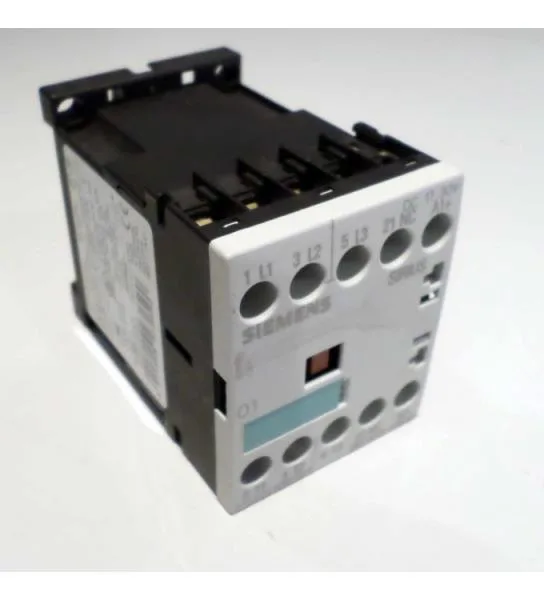
Its 24 VDC coil pulls in reliably across the 0.8 to 1.1 x Us range at 50 Hz and 0.85 to 1.1 x Us at 60 Hz, so it holds in during brownout conditions down to about 19.2 V. The main contacts are rated 10 A at 24 V, 6 A at 230 V, and 3 A at 400 V — these are the thermal continuous currents; for motor duty, the AC-3 rating at 400 V is 3 kW, and the AC-4 rating (plugging/reversing) is 6.5 A.
Mounting, wiring, and panel fit
The 45 mm width and 57.5 mm height mean it occupies a single 45 mm module on the rail; depth is 72 mm, so leave clearance for wiring behind the panel door. Terminals accept 2x (0.5 to 1.5 mm²), 2x (0.75 to 2.5 mm²), or max 2x (0.75 to 4 mm²) solid/stranded, or AWG equivalents 2x (20 to 16), 2x (18 to 14), 1x 12.
Environmental limits and protection
Pollution degree 3 (conductive pollution, typical for industrial enclosures). Front and terminal protection is IP20 — finger-safe but not sealed; keep it inside a panel rated for the environment. Mechanical endurance is 30 million operations typical, so it outlasts most loads in normal cycling.
Fuse coordination for short-circuit protection
For Type 2 coordination (contactor remains operational after a fault), use a 20 A gL/gG fuse. This is the manufacturer's recommendation — do not oversize the fuse beyond these values if you want the coordination type to hold.