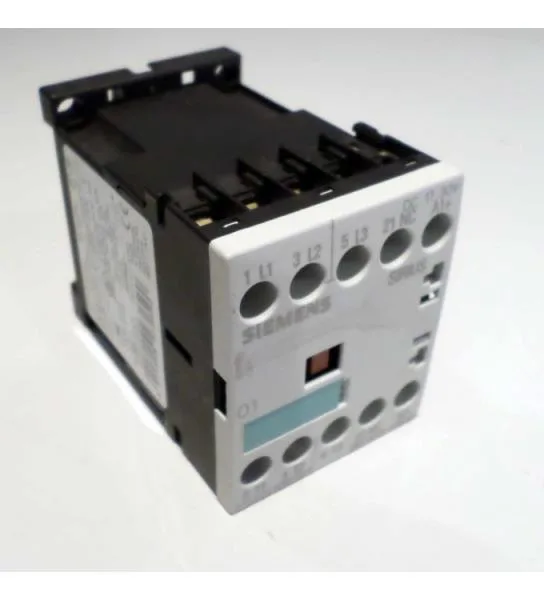
This is a Siemens SIRIUS 3RT1015-1AR62 power contactor — size S00, which is the compact frame in the SIRIUS family, intended for switching motor loads in control panels up to about 4 kW at 690 V. The 24 VDC coil pulls in at the rated voltage and the main contacts are rated 10 A for AC-12 duty (resistive loads), but the real selection numbers are the motor-duty ratings: 3 kW at 400 V in AC-2 (slip-ring motors, braking) and 6.5 A at 400 V in AC-4 (plugging, inching). It mounts via screw or snap-on onto a 35 mm DIN rail per EN 50022, and side-by-side mounting is allowed — so you can pack several in a row without derating for heat buildup, as long as the ambient stays within -25 to +60 °C. The front is IP20, the terminals are IP20, and pollution degree 3 means it's suited for industrial environments where conductive dust or condensation is expected — typical for an enclosed panel.
Sourcing and lifecycle — current production, no LTB worry
Terminal details and wiring fit
The main current circuit uses screw-type terminals that accept solid or stranded conductors: 2x (0.5...1.5 mm²), 2x (0.75...2.5 mm²), or max 2x (0.75...4 mm²). AWG equivalents are 2x (20...16), 2x (18...14), 1x 12. For type 2 coordination (no weld under fault), the required upstream fuse is gL/gG 20 A; for type 1 coordination (weld allowed, replace contactor), it's 35 A. That's the selectivity call the panel designer needs to make.
The headline 10 A at 24 V is the AC-12 resistive rating — that's for heaters or lighting, not motors. The motor-duty numbers are lower: 3.5 kW at 500 V and 4 kW at 690 V, both at 50 Hz. At 60 Hz the coil operating range is 0.85...1.1 x rated voltage, same as 50 Hz. Electrical life depends on the switching current and duty cycle; for AC-4 at 6.5 A expect significantly fewer, but the mechanical figure tells you the frame is built for high-cycle applications like conveyor indexing. Most panel installations are below this, but worth noting for high-altitude sites.