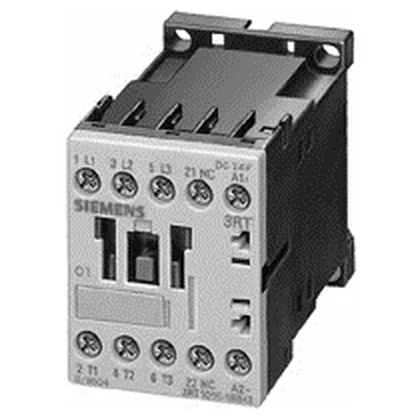
At 45 mm wide, it fits tightly in a crowded enclosure — the side-to-side clearance is only 6 mm, so zero-gap stacking is fine as long as you respect the derating for side-by-side mounting. The DC magnet coil pulls 3.3 W on close and holds at 3.3 W — no dropout trickery, just a steady draw that keeps the armature seated. Rated for AC-2 duty at 4 kW on 400 V, meaning it handles slip-ring motor starts with moderate inrush. For reversing or inching (AC-4), the rating drops to 8.5 A at 400 V — that's the figure to watch if your cycle count is high. Terminals accept 2x (0.5 to 1.5 mm²) solid or 2x (0.75 to 2.5 mm²) stranded, with a max of 2x 4 mm². AWG equivalents are 2x 20–16 solid, 2x 18–14 stranded, or 1x 12. The front and terminal faces are IP20 finger-safe — no shock hazard during panel access.
Mounts with a screw or clips onto 35 mm DIN rail. The S00 footprint is 45 mm wide × 57.5 mm tall × 72 mm deep — that depth matters when you're laying out the gland plate or routing cables behind the backplane. Side-by-side mounting is allowed, but if you pack them tight, check the thermal derating curve in the datasheet. The rated altitude tops out at 2 000 m — above that, air density drops and the contactor's thermal and dielectric margins shrink.
That's the difference between protecting the contactor vs protecting the circuit — pick your coordination class based on whether you want to reuse the contactor after a weld. Compared to the 3RT1016-1AG61 (which uses an AC coil), this -1BM42 variant runs on DC. That changes the control transformer sizing — DC coils don't have the same inrush spike as AC, so the 3.3 W hold power is steady. If your panel was wired for an AC coil contactor like the 3RT1016-1AG61, swapping in this DC version means you need a DC supply or a rectifier on the coil circuit. The mechanical footprint is the same S00 size, so it fits the same DIN rail and terminal layout.