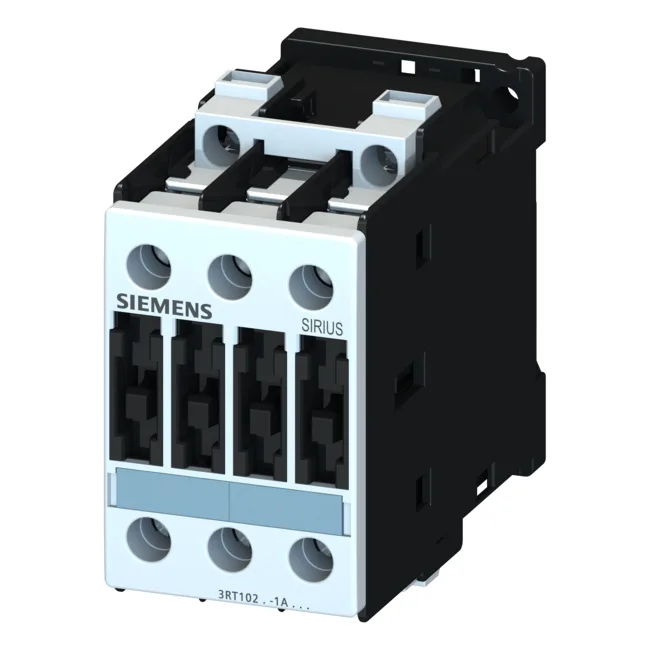
What this contactor is and what it does
The Siemens 3RT1025-3BD40 is a SIRIUS power contactor in frame size S0, built for switching three-phase motor loads up to 11 kW at 690 V. It carries three normally-open main contacts and a 42 VDC coil that draws 5.4 W on both closing and holding — a single-wattage coil, so the control transformer sees a steady load. The contactor mounts via screw or snap-on onto 35 mm DIN rail per EN 50022, which is the standard rail in any European-spec panel.
Motor power ratings — what they mean for your load
The 3RT1025-3BD40 is rated for motor switching in AC-3 duty (starting and disconnecting squirrel-cage motors under load). At 400 V it handles 7.5 kW; at 500 V, 10 kW; at 690 V, 11 kW. In AC-2 duty (slip-ring motors) at 400 V it also carries 7.5 kW. The AC-4 rating at 400 V is 15.5 A — that's the inching/plugging current, which is the harder thermal cycle. If your application involves frequent reversing or jogging, that AC-4 figure is the one to size against.
Panel fit and wiring constraints
The contactor body is 45 mm wide, 85 mm tall, and 100 mm deep — a compact S0 footprint that leaves room for auxiliary contact blocks on the side (6 mm clearance needed). The screw-type main terminals accept 2x (0.25 to 2.5 mm²) solid, 2x (1 to 2.5 mm²) stranded, or up to 2x 10 mm² single-core. For AWG, that's 2x (16 to 12) solid or 2x (14 to 10) stranded, with a maximum single 8 AWG. The front face is IP20 (finger-safe), the terminal area is IP00 — so live parts are exposed at the wiring point; keep the panel door interlocked or use a shrouded terminal cover. Operating temperature range is -25 to +60 °C, pollution degree 3 (industrial environment).
Coordination and protection
For type 2 coordination (no damage to the contactor under short circuit), the required upstream fuse is gL/gG 25 A. For type 1 coordination (contactor may need replacement after fault), the fuse can be gL/gG 63 A. The contactor itself has a mechanical life of 10 million operations typical — that's the unloaded switching endurance; electrical life depends on the load current and duty cycle.
