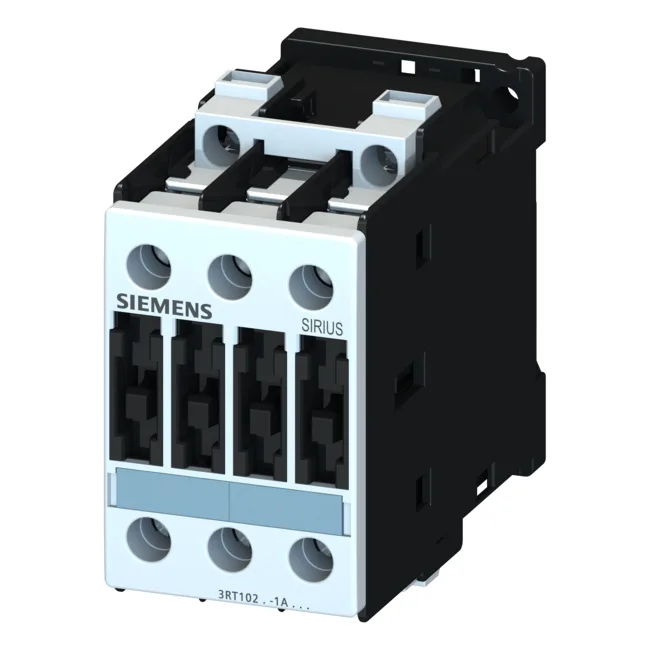
What this contactor is and what it does
The Siemens 3RT1026-1BB40-ZW96 is a SIRIUS power contactor in the S0 frame size, designed for switching motor loads and resistive loads in industrial control panels. It mounts on a 35 mm DIN rail per DIN EN 50022, with a 45 mm width that fits standard enclosure spacing. The 24 VDC coil draws 5.4 W during both closing and holding, so the power supply sizing is straightforward — no inrush spike to over-spec for. Rated for 11 kW at both 500 V and 690 V in AC-3 duty, this contactor handles typical three-phase induction motors up to that power. The AC-4 rating of 15.5 A at 400 V covers reversing or inching applications where the contacts make and break under load more frequently. For resistive loads (AC-12), the maximum operating current is 10 A. The IP20 protection on the front means it is safe for finger contact inside a closed panel; the terminal area is IP00, so live parts are exposed during wiring — standard for panel-mount contactors. Pollution degree 3 rating confirms it tolerates conductive dust and humidity typical of factory floors without conformal coating.
Wiring and coordination specifics
Screw terminals on the main circuit accept 2x (0.5 to 1.5 mm²), 2x (0.75 to 2.5 mm²), or up to 2x (0.75 to 4 mm²) solid wire — or 2x (1 to 2.5 mm²) and up to 2x 10 mm² stranded. AWG equivalents are 2x (16 to 12) and 2x (14 to 10) for the smaller range, with a single 8 AWG maximum. This covers most panel wiring up to about 4 kW motor circuits directly. Short-circuit coordination matters: with type 2 coordination (contactor survives a fault ready for reuse), the required upstream fuse is gL/gG 35 A. For type 1 coordination (contactor may need replacement after a fault), a 100 A gL/gG fuse is permitted. The 6 mm side clearance is the minimum for side-by-side mounting without derating. Operating temperature range is -25 to +60 °C. Maximum altitude is 2 000 m.
Lifecycle and sourcing reality
The reference code Q per DIN EN 81346-2 indicates it is intended as a power switching device in the functional schematic — useful for documentation traceability when matching nameplates to panel drawings.
