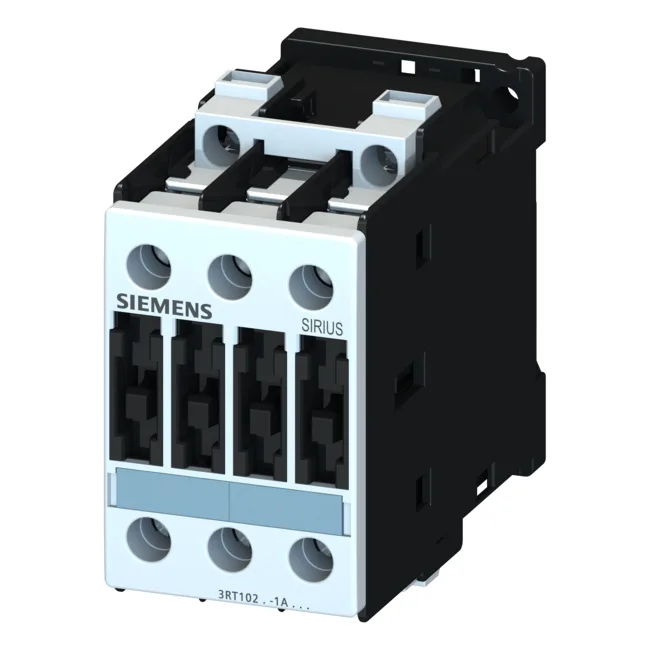
Coil is 24 VDC, pulling 5.4 W on close and holding at the same 5.4 W — a constant-power magnet circuit, so no inrush spike to size your DC supply around. Rated for AC-2 duty at 11 kW / 400 V (slip-ring motor starting) and AC-4 at 15.5 A / 400 V (plugging/inching). For fixed-speed squirrel-cage motors, the AC-3 rating is the one that governs — the part switches 11 kW at both 500 V and 690 V, so it covers 400 V class motors comfortably with headroom.
Width is 45 mm, height 85 mm, depth 100 mm — fits the standard S0 footprint. Side-by-side mounting is allowed (zero gap), so you can pack a row of these on the rail without derating for heat buildup, provided the ambient stays within the -25 to +60 °C window. Main contact terminals accept 2x (1 to 2.5 mm²), 2x (2.5 to 6 mm²), or max 2x 10 mm² stranded — or AWG equivalents 2x (16 to 12), 2x (14 to 10), 1x 8. Solid wire range is 2x (0.25 to 2.5 mm²). Strip and torque per the terminal marking; no ferrule required for stranded if the strands are twisted.
Short-circuit coordination
That's the selectivity window the panel designer needs to match to the branch circuit protection.
Auxiliary contact switching
The built-in auxiliary contacts handle 10 A at 24 V, 6 A at 230 V, 3 A at 400 V, and 2 A at 60 V — covering typical PLC input and relay coil loads across common control voltages. At 110 V it's 1 A; at 220 V it's 0.3 A.