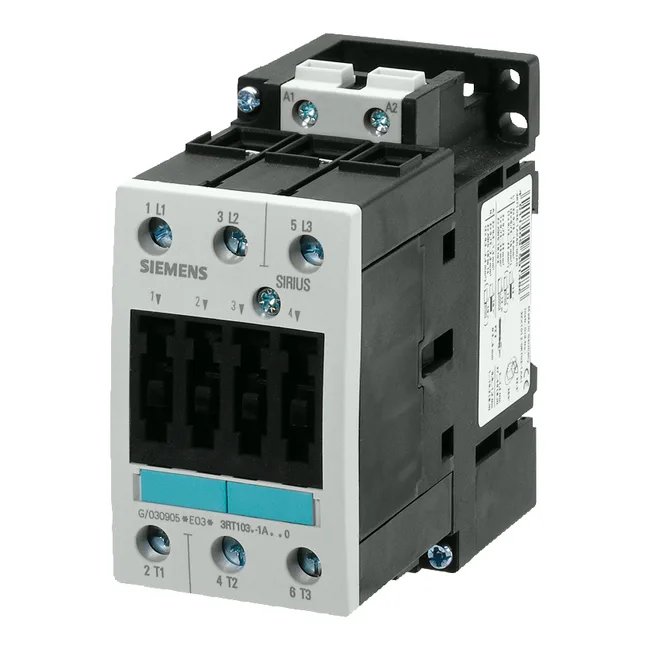
The 3RT1034-1AP64: The AC-3 rating of 18.5 kW at 500 V is the one that governs motor switching — it tells you the contactor can break the locked-rotor current of a motor up to that power. The AC-2 rating of 15 kW at 400 V covers slip-ring motor starting, where the current stays lower but the switching frequency can be higher. The 690 V rating of 10 kW means it can also serve motors on 690 V three-phase systems, common in heavy industrial plants. The coil is rated for 220 V at 50 Hz and 240 V at 60 Hz, with an operating range of 0.8 to 1.1 times the rated voltage at both frequencies. That means the coil holds in reliably even if the line sags to 176 V on a 220 V system, and won't overheat at 242 V. Auxiliary contacts are rated at 10 A at 24 V, 6 A at 230 V, and 3 A at 400 V — these are the switching limits for the control circuit, not the main power path. Use them for PLC inputs or contactor feedback, but stay within the voltage-specific current limits.
The IP20 front face protects against finger contact; the terminal area is IP00, meaning the wiring zone is open and must be inside an enclosure. That covers most motor feeder cables up to 6 mm² for the 18.5 kW rating; for larger cables, check the terminal capacity against your wire size.