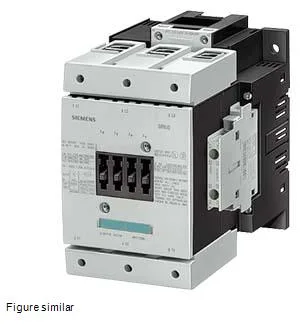
The 170 mm depth and 140 mm width fit standard enclosure layouts, but the 172 mm height is worth checking against your panel's internal clearance — it's taller than many S6 frames.
The coil pulls in at 80-90 ms on both AC and DC supplies, with dropout below 0.8x rated voltage. That's a standard operating speed for a contactor this size — fast enough for most motor starts, not so fast that it causes nuisance dropouts on a sagging line. Arcing time runs 10-15 ms, which matters for contactor life on high-inrush loads like motors or transformers. Switching frequency limits are given per duty class: 1,000 cycles/hour for AC-3 and AC-3e (standard motor starting), 800 for AC-1 (resistive), 400 for AC-2 (slip-ring motors), and only 130 for AC-4 (plugging/inching). If your application requires frequent reversing or jogging, the AC-4 limit of 130 ops/hour is the binding constraint — don't spec this contactor for a high-cycle reversing conveyor without checking that duty cycle. Auxiliary contact ratings cover the common control voltages: 10 A at 24 V, 6 A at 230 V, 3 A at 400 V, and 0.3 A at 220 V DC. The DC switching capacity drops sharply with voltage — at 220 V DC it's only 0.3 A, so verify your DC control loads don't exceed that curve. The 60 °C ceiling is typical for a panel-mounted contactor; if your enclosure sees higher ambient (near a furnace or in direct sun), you'll need to derate or move to a ventilated cabinet.
Fastened by screw fixing, not snap-on DIN rail. That means a drilled backplate and threaded inserts — plan for that in the panel layout. The 20 mm forward clearance is the one that catches people out; make sure the enclosure door or busbar system leaves that gap. Main circuit wiring accepts solid conductors 2x (0.5-1.5 mm²), 2x (0.75-2.5 mm²), or max 2x (0.75-4 mm²). Stranded cable goes up to 1x 50 or 1x 70 mm². That's a wide range — fine for both control wiring (smaller gauges) and power feeds (larger gauges). Use ferrules on stranded wire for reliable screw-terminal connections.