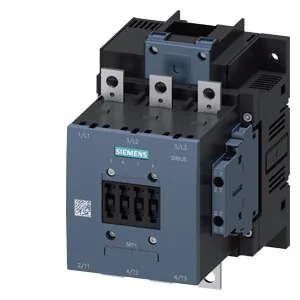
The main power circuit accepts stranded conductors from 25 mm² up to 120 mm², which covers motor feeds up to about 55 kW at 400 V (rough rule — verify against your motor FLA). Switching frequency depends on duty: AC-1 (resistive) at 800 ops/h, AC-3 (squirrel-cage motor start/run) at 750 ops/h, AC-4 (plugging/inching) at 130 ops/h. The AC-3e rating mirrors the AC-3 figure at 750 ops/h. For a conveyor line cycling every 30 seconds, that's well within the AC-3 ceiling; for a press brake doing rapid reversals, you'll want to stay under the AC-4 limit. Auxiliary contacts are present — the built-in switch block is rated 10 A at 24 V, 2 A at 48 V and 60 V, and 1 A at 110 V.
This contactor uses screw fixing (bolt-through), not DIN-rail snap-on. Mounting surface must be vertical, with ±90° rotation allowed and ±22.5° tilt forward/back. That gives flexibility for tight enclosures, but it's not a DIN-rail part — budget for a backplate and drilled holes. Footprint: 172 mm high, 120 mm wide, 170 mm deep. That's a substantial block — size S6. Clearance requirements: 10 mm above and below, 20 mm in front, 10 mm to the sides. A standard 600x600 mm enclosure can hold a few of these side by side, but watch the depth if the panel door has a deep component (like a disconnect handle) behind the contactor.
Wiring and terminations
Main power terminals accept stranded 25-120 mm² — that's a single large conductor or two smaller ones. The auxiliary circuit terminals are screw-type as well, accepting 2x (0.5-1.5 mm²) solid or 2x (0.75-2.5 mm²) stranded, max 2x (0.75-4 mm²). Use ferrules on stranded auxiliary wires to avoid strand spread under the screw. Operating delay is 40-60 ms on both AC and DC coil pickup — consistent, not unusually fast. Arcing time is 10-15 ms, which is typical for this frame size. For the coil, the rated value of 0.8 power factor at 50/60 Hz means the inrush current is moderate; the initial value is also 0.8. No suppression built in — add a varistor or RC snubber across the coil if driving from a PLC output.