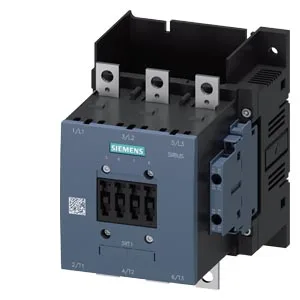
The main circuit accepts stranded conductors from 25 to 120 mm², which covers motor feeds up to roughly 200 A depending on duty — the 230 V motor rating is 30 hp, a solid benchmark for a 30–40 kW motor at 400 V three-phase. The auxiliary contact block is rated at 10 A at 24 V and derates to 0.3 A at 230 V, so it can drive PLC inputs or small relays at control voltage but needs checking if you're switching a 230 V pilot light at the full 10 A — it won't. Switching frequency varies by duty class: AC-1 (resistive) allows 800 operations per hour, AC-3 (squirrel-cage motor start/run) allows 750, and AC-4 (plugging/inching) drops to 130. That AC-3 figure is the one most buyers care about — 750 ops/h is enough for a fast cycling line but not for a servo-style reversing application. The 60 °C ceiling is fine for most indoor panels but marginal for a sun-baked enclosure in a Middle East plant — if ambient inside the panel hits 55 °C, you're still within spec but should derate the current per the manufacturer's curve (not included here).
The contactor measures 172 mm high by 120 mm wide by 170 mm deep — that's a substantial footprint, so check your DIN-rail or backplate real estate before committing. The coil terminals are screw-type, and the auxiliary wiring accepts solid or stranded conductors: 2x 0.5–1.5 mm², 2x 0.75–2.5 mm², or max 2x 0.75–4 mm². That covers standard control wiring but won't accept a single 6 mm² — plan your terminal blocks accordingly.