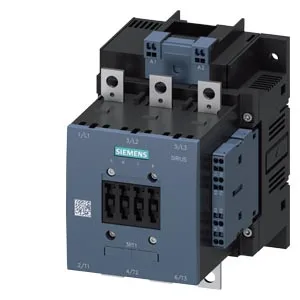
SIRIUS S6 power contactor — what you're looking at
It carries a 575–600 V AC coil and includes an auxiliary switch block. The magnet coil terminates on spring-type terminals (2x 0.25–2.5 mm² solid or stranded), while the main power circuit accepts stranded conductors up to 120 mm².
The contactor measures 172 mm high, 120 mm wide, and 170 mm deep — that's a substantial footprint for a size S6 frame. Mounting is by screw fixing (single 9 mm hole) on a vertical surface, with ±90° rotatability and ±22.5° tilt front-to-back. The spring-type terminals on the coil save wiring time — strip 8–10 mm, push in — but the main power terminals are screw-type for the 25–120 mm² stranded range.
Duty cycle and switching frequency
This contactor is rated for different switching frequencies depending on the duty category: 800 operations/hour in AC-1 (resistive), 750/h in AC-3 and AC-3e (motor starting/running), 300/h in AC-2 (slip-ring motors), and 130/h in AC-4 (plugging/inching). That means it's fine for high-cycle conveyor or pump starts (AC-3 at 750/h) but not for high-speed jogging — AC-4 at 130/h is the limit there.
Auxiliary contact capacity
The built-in auxiliary switch is rated at 10 A at 24 V, 2 A at 48 V, 2 A at 60 V, and 1 A at 110 V — all AC rated values. That covers most PLC input or relay coil loads in a 24 VDC control circuit, but at 110 V the 1 A limit means you can't drive multiple contactor coils from one auxiliary contact.