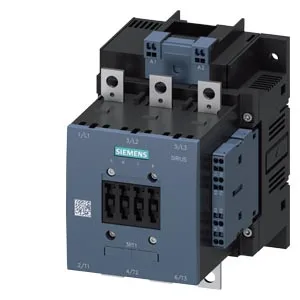
The 3RT1056-2AU36: The S6 frame size (172 mm high, 120 mm wide, 170 mm deep) determines the panel cutout and backpan space. Mounting is by screw fixing through a single 9 mm hole, with the contactor body rotatable ±90° on a vertical surface and tiltable ±22.5° front-to-back — useful for tight enclosures where the gland plate or busbar layout forces an angled install. These are the numbers the panel designer needs to avoid derating from restricted airflow.
Switching duty and endurance
Maximum switching rates vary by duty: 800 cycles/hour under AC-1 (resistive), 750 under AC-3 (standard motor starting), and 130 under AC-4 (plugging/inching). The AC-3e rating matches the AC-3 figure at 750 cycles/hour. For a motor starter running at 30 starts/hour, this contactor will outlast the machine rebuild cycle. Arcing time is 10-15 ms, and total operating time (both AC and DC coil) is 40-60 ms — fast enough for most safety circuits that don't require a forced-guided contactor.
Auxiliary contact block and wiring
The contactor comes with an integrated auxiliary switch, rated 10 A at 24 V, 2 A at 48 V and 60 V, and 1 A at 110 V. This is enough for a feedback signal to a PLC input and a status lamp in parallel, without needing a separate terminal block. The coil terminals are spring-type — no screw torque to verify, which speeds panel wiring and eliminates a common QA re-torque step.
Environmental limits
The operating factor is 0.8 at both 50 Hz and 60 Hz, with a full-scale value of 1.1 and an initial value of 0.8. This means the coil can tolerate a sustained overvoltage of 10% above nominal, and will pick up reliably at 80% of rated voltage — important for long cable runs where voltage drop is a concern.