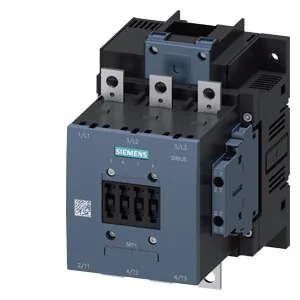
The Siemens SIRIUS 3RT1056-6AU36 is a power contactor in the S6 frame size, with a 240-277 V AC coil and screw-type terminals. The main power circuit accepts stranded conductors from 25 to 120 mm².
The 3RT1056-6AU36 rates its maximum switching frequency differently per duty class: AC-1 (resistive loads) allows up to 800 operations per hour, AC-3 (squirrel-cage motor starting) allows 750 ops/h, AC-2 (slip-ring motor starting) allows 300 ops/h, and AC-4 (plugging/inching) drops to 130 ops/h. For a conveyor line running AC-3 duty at 750 ops/h, that is one start every 4.8 seconds — comfortable for most material-handling cycles. AC-4 at 130 ops/h reflects the heavier arc wear from reversing or inching; pushing past that rate accelerates contact erosion. Arcing time is 10-15 ms, and the mechanical service life of the contactor is typically 10 million operations.
Wiring and auxiliary switch provisions
The main power circuit accepts stranded conductors from 25 to 120 mm² — a single cable or two parallel runs per phase. The coil terminals accept solid or stranded wires: 2× (0.5-1.5 mm²), 2× (0.75-2.5 mm²), or max 2× (0.75-4 mm²). The contactor comes with an auxiliary switch (1 N/O + 1 N/C typically), which is useful for feedback to a PLC or for electrical interlocking. The single 9 mm mounting hole suits M8 hardware. Overall dimensions are 170 mm deep, 120 mm wide, 172 mm high — confirm backplate layout before committing the BOM line.