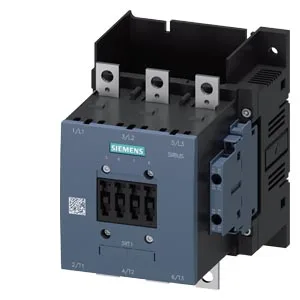
It is screw-fixed to a mounting surface, with a vertical mounting surface that can be rotated ±90° or tilted ±22.5° forward and back, giving flexibility in enclosure layout. The contactor carries an auxiliary switch and the coil terminates on screw-type terminals.
The AC-3 switching frequency is rated at 750 operations per hour (AC-3e same), which governs typical motor start-stop cycles; AC-4 (plugging/reversing) drops to 130 operations per hour. For resistive loads (AC-1) the contactor manages 800 operations per hour. These figures define the thermal duty cycle — exceeding them risks contact welding or premature wear. The mechanical endurance is 10,000,000 operations typical, so the limiting factor in most applications will be electrical life under load, not the mechanism. The main power circuit accepts stranded cable from 25 to 120 mm², sized for the S6 frame's current-carrying capacity. Auxiliary and control wiring uses solid or stranded conductors: 2x (0.5 to 1.5 mm²), 2x (0.75 to 2.5 mm²), or max 2x (0.75 to 4 mm²). The auxiliary contact ratings are given per voltage — at 24 V it carries 10 A, at 230 V it carries 0.3 A — so confirm the control voltage and load current against these values for the specific aux contact being used. These are consistent with a contactor of this size and class; they matter for coordination with upstream short-circuit protection devices.
The contactor measures 172 mm high, 120 mm wide, and 170 mm deep. It is fastened with a single 9 mm diameter hole. These are minimum air gaps to maintain rated insulation and thermal dissipation — plan the enclosure layout accordingly, especially when grouping multiple contactors. The storage figure covers handling and warehousing, not running conditions. If the panel ambient exceeds 60 °C, derating or forced ventilation is required.