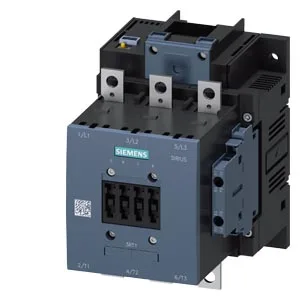
The contactor occupies a 172 mm height, 120 mm width, and 170 mm depth footprint, so verify the DIN rail or backplate clearance before committing the BOM line.
The magnet coil is rated 21 to 27.3 V, with a pickup of 0.8 times the rated value and a dropout of 1.1 times the full-scale value — so on a 24 VDC control bus it pulls in reliably and drops out cleanly, critical for safety circuits. Switching frequency ranges from 130 operations per hour in AC-4 duty (plugging/inching) up to 800 operations per hour in AC-1 (resistive) — the AC-3 motor rating at 750 ops/h covers most conveyor and pump applications. Auxiliary contacts are included, so no separate add-on block is needed for status feedback to the PLC.
Main power terminals accept stranded conductors from 25 to 120 mm², sized for the S6 frame's current-carrying capacity. The coil connection uses screw-type terminals accepting 2x (0.5 to 1.5 mm²) solid or 2x (0.75 to 2.5 mm²) stranded, with a maximum of 2x (0.75 to 4 mm²) — standard for control wiring in a panel. A single 9 mm mounting hole is provided for screw fixing; plan for the specified 10 mm clearance at the sides and 10 mm above/below for heat dissipation and arc flash clearance.