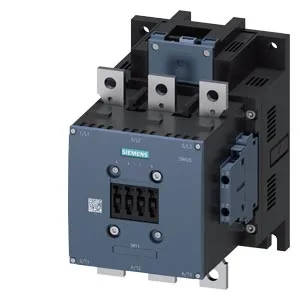
Duty-cycle switching frequencies – the so-what
The maximum switching frequency varies by duty class: AC-1 (resistive) at 750 operations per hour, AC-3 (motor starting) at 500 ops/h, AC-4 (plugging/inching) at 130 ops/h, and AC-2 at 250 ops/h. The AC-3e rating also sits at 500 ops/h. For a motor starting application, that 500 ops/h translates to about one start every 7 seconds — fine for a conveyor or pump, but if your application needs faster cycling (like a rapid indexing table), you'll need to move to a smaller frame or derate.
Auxiliary contact ratings and opening times
The auxiliary contacts are rated at 24 V / 10 A, 48 V / 2 A, 60 V / 2 A, and 110 V / 1 A. That covers standard control voltages; if you're switching a 24 VDC PLC output, the 10 A rating gives plenty of margin. Opening delay is 80–100 ms on both AC and DC supplies — consistent enough for sequencing logic that doesn't need sub-cycle timing. Arcing time is listed at 10–15 ms. That's typical for a contactor of this size and doesn't drive any special suppression beyond the usual RC snubber across the coil.
Wiring and cable entry
The main power circuit accepts stranded cable from 70 to 240 mm² (stranded: 70... 240 mm²). That's a heavy cable range — suitable for the S10 frame's typical current draw. The auxiliary/control terminals accept solid or stranded wire: 2x (0.5... 1.5 mm²), 2x (0.75... 2.5 mm²), max. 2x (0.75... 4 mm²). That covers standard control wiring up to 4 mm², which is enough for most 24 VDC loops.