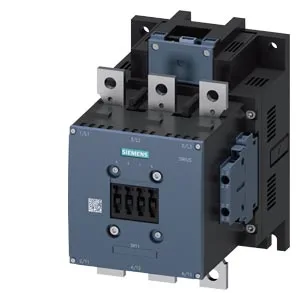
SIRIUS S10 power contactor, 24 V DC coil — current production
The 3RT1064-6XB46-0LA2: The coil holds at 24 V DC nominal; dropout timing sits at 80 to 100 ms after the control voltage is removed, which matters for sequencing logic that expects a predictable off-delay on the main power path. Arcing time is specified at 10 to 15 ms — a narrow window that helps with contact erosion estimates in high-cycle applications.
Maximum switching frequency varies by duty class: 700 operations per hour under AC-1 (resistive loads), 500 under AC-3 and AC-3e (standard motor starting), 250 under AC-2 (slip-ring motor), and 130 under AC-4 (plugging/inching). For DC loads, the contactor manages 350 ops/h under DC-1, and 250 under DC-3 and DC-5. These are the hard limits for the contactor's thermal recovery between cycles — exceeding them accelerates contact wear regardless of the load current.
Auxiliary contact ratings — DC switching capability
Its DC switching capacity is rated per voltage: 6 A at 24 V, 2 A at 48 V and 60 V, 1 A at 110 V, and 0.9 A at 125 V. These are the maximum currents the auxiliary contacts can interrupt at those voltages — useful for driving PLC inputs, relay coils, or indicator lamps in the control circuit.
Mounting and wiring — panel integration notes
Mounting is by screw fixing through a single 11 mm hole. Screw terminals accept solid or stranded wire: 2x 0.5 to 1.5 mm², 2x 0.75 to 2.5 mm², or a maximum of 2x 0.75 to 4 mm² per clamp. This covers standard control and power wiring up to 4 mm² without needing lug adapters.
Environmental range
The wider storage limit governs handling and transport, not running conditions.