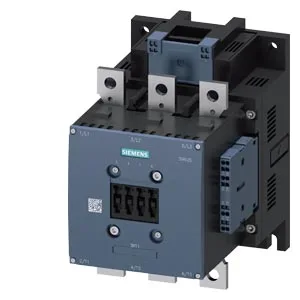
That spring cage on the coil saves a few seconds per termination compared to screw-clamp — small gain, adds up on a multi-contactor panel. Power wiring takes stranded 70–240 mm²; auxiliary wiring takes solid or stranded 2x 0.25–2.5 mm². The auxiliary switch is present on this variant, rated 10 A at 24 V, 2 A at 48 V or 60 V, 1 A at 110 V — covers typical PLC-level signal switching.
The real duty limit is the electrical switching frequency: 800 ops/h in AC-1 (resistive), 500 ops/h in AC-3 (motor start/run), 130 ops/h in AC-4 (plugging/inching). If the application runs frequent reversals, that 130 ops/h ceiling is the one that governs contact life. Operate time is 40–80 ms on both AC and DC pickup; arcing time runs 10–15 ms. That's typical for a contactor this size — not a fast-switching device, but fine for motor starting and isolation. That 20 mm forward gap is the one that catches people — not much, but if the panel door or a busbar shroud sits tight, measure it. The storage range is wider, but that's the handling limit, not the running limit.
Integration notes
Mounts via screw fixing through a single 11 mm hole. Panel cutout is straightforward — one hole, not a DIN-rail clip. The Size S10 frame is the physical footprint; verify the 210 mm height, 145 mm width, 202 mm depth against the enclosure backplate before committing the layout.