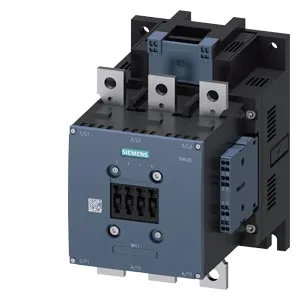
The 3RT1065-2AS36: Rated control supply voltage spans 500 to 550 V AC, with a pick-up threshold of 0.8 × rated value. The coil connects via spring-type terminals — no screwdriver needed for the control wiring, which speeds panel assembly and reduces torque-check steps.
Duty-cycle capability and mechanical life
Switching frequency varies sharply by duty class: 800 operations per hour in AC-1 (resistive loads), 500/h in AC-3 (standard motor starting), 250/h in AC-2 (slip-ring motors), and 130/h in AC-4 (plugging/inching). The AC-3e rating also sits at 500/h. These numbers govern the thermal load on the contactor — pushing AC-4 cycles into an AC-3 application overheats the arc chamber.
Terminal capacity and auxiliary contacts
Main power terminals accept stranded conductors from 70 to 240 mm² — sized for the S10 frame's current range. The auxiliary circuit terminals handle 2 × (0.25 to 2.5 mm²) solid or stranded, which covers standard 24 VDC control wiring and feedback loops. The contactor ships with an auxiliary switch block (1 N/O + 1 N/C configuration typical for SIRIUS S10). Its rated breaking capacity at 24 V is 10 A; at 110 V it drops to 1 A. That derating matters when driving PLC inputs or relay coils at higher control voltages.
Fastening is screw fixing through a single 11 mm hole, with the vertical mounting surface rotatable ±90° and tiltable ±22.5° front-to-back. Clearance distances: 10 mm upwards, downwards, and to the side; 20 mm forwards.
Lifecycle stage is marked as current.