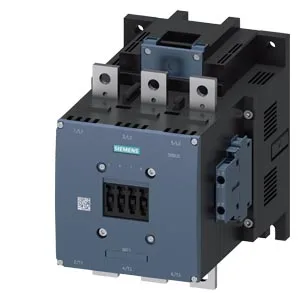
Panel fit and conductor sizing
The 3RT1076-6AF36: At 225 mm deep, 160 mm wide, and 214 mm tall, this contactor needs a solid backpanel — the S12 frame is one of the larger sizes in the SIRIUS line. The main power circuit accepts stranded conductors from 70 up to 240 mm², so plan for lug or crimp terminations that match that cross-section. Auxiliary circuits take solid or stranded wire from 0.5 to 4 mm², with dual-entry options for daisy-chaining. Mounting is by screw fixing through an 11 mm hole, with the contactor body rotatable ±90° on a vertical surface and tiltable ±22.5° front-to-back. Keep 10 mm clearance at the sides, top, and bottom, and 20 mm forward for arc chute venting.
Duty-cycle ratings and switching life
The contactor is rated for different switching frequencies depending on the utilization category: 500 operations per hour in AC-1 (resistive), 420 in AC-3 (squirrel-cage motor start/run), 170 in AC-2 (slip-ring motor), and 130 in AC-4 (plugging/inching). The AC-3e rating matches the AC-3 figure at 420 ops/h. Typical mechanical life is 10 million operations, so for a line running at 420 ops/h that's about 24,000 hours of switching before mechanical wear is a concern. Opening and closing times are 60-100 ms for both AC and DC operation, with an arcing time of 10-15 ms. The power factor at rated load is 0.9 at both 50 and 60 Hz — standard for motor loads. The overload release full-scale value is set at 1.1 times the rated current.
Environmental limits and auxiliary contact capacity
Operating temperature range is -25 to +60 °C, with storage from -55 to +80 °C — fine for most indoor panel environments but check if the panel ambient near a furnace or chiller line pushes past 60 °C. The auxiliary switch is present and rated: 10 A at 24 V, 2 A at 48 V and 60 V, and 1 A at 110 V. That's enough for a PLC input or a pilot light, but not for driving a second contactor coil directly at 110 V.