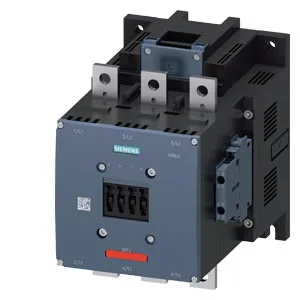
SIRIUS S12 power contactor — panel fit and duty-cycle reality
The 3RT1076-6AP36-3PA0 is a Siemens SIRIUS Size S12 power contactor, designed for switching motor loads and resistive loads in industrial control panels up to 690 V. Screw fixing through an 11 mm hole is the mounting method — no DIN rail clip on this variant, so budget panel drilling and a screwdriver during installation. Mounting position is flexible: vertical surface with ±90° rotation and ±22.5° tilt front-to-back, which helps when the contactor sits in a crowded sub-panel or on a swing frame. The coil is rated 220–240 V AC, screw-type terminals, and the contactor carries a built-in auxiliary switch — no separate add-on block needed for basic feedback.
Duty-cycle limits — what the switching frequencies tell you
Maximum switching rate is duty-class dependent: 500 operations/hour in AC-1 (resistive), 420/h in AC-3 (squirrel-cage motor start/run), 170/h in AC-2 (slip-ring motor), and 130/h in AC-4 (plugging/inching). The AC-3e rating matches the AC-3 figure at 420 ops/h, confirming the contactor is optimised for standard motor starting duty rather than high-cycle inching. Arcing time is 10–15 ms, and operating times (both AC and DC coil) are 60–100 ms — consistent with a general-purpose power contactor, not a fast-transfer switch.
Wiring and thermal envelope
Main power circuit accepts stranded conductors from 70 up to 240 mm² — this is a heavy-current contactor, sized for large motor feeders or busbar tap-offs. Auxiliary/control circuit wiring accepts 2x (0.5–1.5 mm²) solid or 2x (0.75–2.5 mm²) stranded, with a max of 2x (0.75–4 mm²) — covers standard control wiring up to 4 mm². Operating ambient is -25 to +60 °C, storage -55 to +80 °C — fine for most indoor panel environments, but check the derating if the panel internal temperature exceeds 60 °C. Clearance distances are tight: 10 mm upwards/downwards/sideways, 20 mm forwards — plan the panel layout so adjacent components or cable ducts don't crowd these gaps.
Auxiliary contact ratings and mechanical life
The built-in auxiliary switch is rated 10 A at 24 V, 2 A at 48 V or 60 V, and 1 A at 110 V — sufficient for signalling to a PLC input or a pilot light, but not for driving a large contactor coil directly at higher voltages. Mechanical endurance is 10 million operations typical — the contactor itself will outlast most application lifetimes before the mechanism wears, assuming the electrical load stays within the duty-cycle limits.