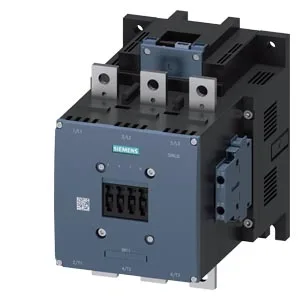
The 72 VDC coil means this is a DC-operated unit, which avoids the AC hum and coil-burnout issues common with AC coils in high-duty-cycle applications. The contactor is screw-fixed to the mounting surface, not DIN-rail snap-on, so plan for panel drilling — the mounting holes are 11 mm diameter, one hole per the spec.
The auxiliary contact block is present (Auxiliary Switch: Yes) and rated for DC switching at multiple voltages: 6 A at 24 V, 2 A at 48 V, 2 A at 60 V, 1 A at 110 V, 0.9 A at 125 V, and 0.3 A at 220 V. These are the DC-13 or similar inductive load ratings — if you're switching a PLC input or a small DC relay at 24 V, the 6 A rating gives comfortable headroom. At 220 VDC the 0.3 A rating is the limit; don't expect to switch a 1 A DC motor brake at that voltage.
The 225 mm depth, 160 mm width, and 214 mm height define the envelope — verify your enclosure depth before committing.
Switching performance and life
Mechanical life is typical 10,000,000 operations. Maximum switching rates vary by duty: 500 ops/h at AC-1 (resistive), 420 ops/h at AC-3 (motor starting), 170 ops/h at AC-2, 130 ops/h at AC-4 (plugging/inching), and 250 ops/h at DC-1, 200 ops/h at DC-3 and DC-5. The arcing time is 10-15 ms, and DC operating time is 80-100 ms.