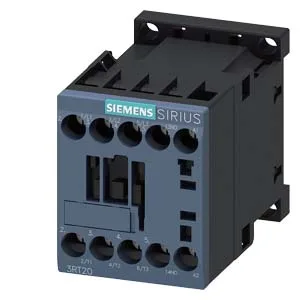
Rated at 10 A at 24 V, this contactor handles auxiliary switching at lower voltages as well — 2 A at 48 V and 60 V, 1 A at 110 V, and 0.9 A at 125 V. The 24 VDC coil is the standard control voltage for many industrial PLC outputs, so it's a common drop-in for panels running 24 V control logic. Mechanical service life is rated at 30,000,000 operations, and the contactor is approved for switching frequencies up to 1,000 cycles per hour under AC-1 resistive loads, 750 under AC-3 motor duty, and 250 under AC-4 (inching/jogging). That means it's built for continuous cycling, not just occasional on/off.
That flexibility helps when fitting into tight or odd-angle panel layouts. Wire terminations accept solid or stranded conductors from 0.5 to 4 mm², and the screw terminals can take two conductors per clamp — 2x 0.5 to 1.5 mm², 2x 0.75 to 2.5 mm², or 2x 4 mm². That's handy for daisy-chaining control wiring without extra terminal blocks.
Auxiliary and switching specifics
The main contacts are rated for 20 to 12 A depending on the utilization category — the AC-1 resistive rating is the highest, while AC-3 motor switching is the typical application for this frame size. At 230 V, the contactor is rated for 0.75 hp, and at 400 V it handles 3 A. That makes it suitable for small motors, pumps, fans, and conveyor drives up to about 0.55 kW at 400 V three-phase.