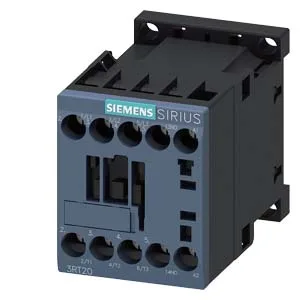
It mounts via screw fixing or snap-on onto 35 mm DIN rail per DIN EN 60715, with a ±180° rotation possible on a vertical surface and ±22.5° tilt forward/backward — useful when panel layout forces an unconventional orientation. The coil termination uses screw-type terminals, and the main contacts accept solid or stranded wire from 0.5 to 4 mm², including dual-wire configurations (2x 0.5–1.5 mm², 2x 0.75–2.5 mm², 2x 4 mm²). An auxiliary switch is integrated, saving a separate add-on block for status feedback or interlocking.
The contactor carries a 24 V rated value of 10 A, dropping to 2 A at 48 V and 60 V, 1 A at 110 V, 0.9 A at 125 V, 0.3 A at 220 V, 3 A at 400 V, and 0.14 A at 440 V — these are the DC switching limits per the datasheet, not the AC motor ratings. For AC-3 motor duty, the maximum operating rate is 750 operations per hour; AC-4 (plugging/reversing) is limited to 250 ops/h.