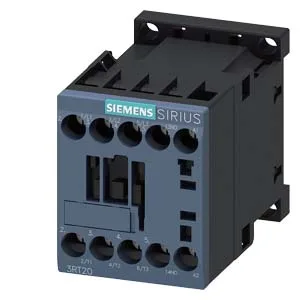
It carries a 24 VDC coil with screw-type terminals and includes an integrated auxiliary switch. The contactor mounts via screw or snap-on onto 35 mm DIN rail per DIN EN 60715, with a compact footprint of 45 mm width, 58 mm height, and 73 mm depth — fitting standard panel layouts without crowding adjacent devices.
The auxiliary contact is rated for switching at various control voltages: 10 A at 24 V, 2 A at 48 V and 60 V, 1 A at 110 V, 0.9 A at 125 V, 0.3 A at 220 V, and 3 A at 400 V — these are the maximum currents the auxiliary circuit can break at those voltages, so match your PLC or relay output ratings against these limits. The contactor is rated for mechanical endurance of 30 million operations typical, with electrical switching rates up to 1000 cycles/hour at AC-1, 750 cycles/hour at AC-2 and AC-3, and 250 cycles/hour at AC-4. Wire termination accepts solid or stranded conductors from 0.5 to 4 mm², with dual-wire capability: 2×(0.5–1.5 mm²), 2×(0.75–2.5 mm²), or 2×4 mm². Keep the strip length clean and use ferrules on stranded wire for reliable screw-clamp contact.