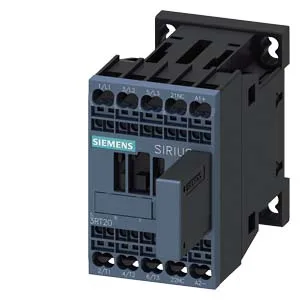
It uses spring-type terminals for the magnet coil, which means no screw tightening — strip, insert, and the cage clamps the wire. The 24 V rated coil holds reliably, and the DC-13 breaking current at 24 V is 10 A, so it handles inductive DC loads like relay coils or solenoid valves without welded contacts.
Electrical ratings and switching performance
Rated control supply voltage is 24 VDC. For DC-13 duty (switching electromagnets), the contactor breaks 10 A at 24 V, 2 A at 48 V and 60 V, 1 A at 110 V, 0.9 A at 125 V, and 0.3 A at 220 V. At 400 V AC-3 motor duty, it switches 3 A. Maximum switching frequency depends on duty: 1,000 operations per hour at AC-1 (resistive), 750 at AC-2 and AC-3 (motor start/run), and 250 at AC-4 (plugging/inching). The main contacts are rated for 20 to 12 million operating cycles, and the typical mechanical service life is 30 million operations.
Environmental and wiring
Accepts solid or stranded conductors from 0.5 to 4 mm² (single wire) or 2x (0.5 to 4 mm²) for paralleled conductors.