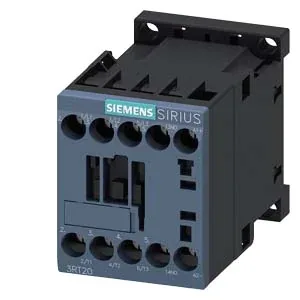
The 24 VDC coil pulls in at 0.8 of rated voltage and holds there; dropout happens below the release threshold, which keeps the contactor from chattering on a sagging bus. At 45 mm wide, 58 mm tall, and 73 mm deep, it fits into tight gland-plate layouts where every millimeter of DIN rail counts.
The coil is rated at 24 VDC, and the main contacts carry 10 A at 24 VDC resistive (AC-1) and 3 A at 400 VAC. That AC-1 number — 10 A — is the resistive load curve; if you're switching motor loads under AC-3 duty, the contactor handles up to its rated operational current for that category, which for this frame size typically lands below the resistive figure. The switching frequency tops out at 1,000 operations per hour for AC-1, 750 per hour for AC-3, and 250 per hour for AC-4 (plugging/reversing). Those limits aren't theoretical — exceed them on a frequent-start conveyor and you'll cook the arc chamber. The 10 mm clearance above and below, plus 6 mm to the side, is the minimum for arc flash and heat dissipation — don't cram it flush against the enclosure wall.
Screw-type terminals on the coil and main contacts accept solid or stranded wire from 0.5 to 4 mm², or two conductors in parallel (2x 0.5...1.5 mm², 2x 0.75...2.5 mm², or 2x 4 mm²). Just keep the arc chamber clearances I mentioned above.