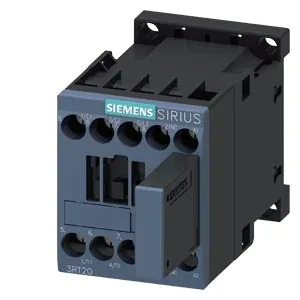
The Siemens 3RT2016-1WB42 is a SIRIUS coupling contactor in size S00, designed for isolating and switching control circuits in automation panels. The 24 VDC coil (0.85 pick-up, 1.85 hold) pulls in reliably down to about 20.4 V and drops out below roughly 18 V — a standard margin for 24 VDC control buses. Screw-type terminals accept solid or stranded wire from 0.5 to 4 mm² (single or two conductors up to 2.5 mm²), so it terminates directly into a standard control-panel terminal block without ferrule adapters. Rated switching frequency hits 1 000 cycles/hour on AC-1 resistive loads, 750 cycles/hour on AC-3 motor loads, and 250 cycles/hour on AC-4 plugging/reversing duty — the AC-4 figure is the one to watch for jogging or inching applications.
The 45 mm width and 117 mm depth fit a standard 45 mm-wide slot in a panel layout; mounting position allows ±180° rotation on a vertical surface and ±22.5° tilt forward/backward, so it adapts to tight enclosures or angled sub-panels. Clearance spacing: 10 mm upwards, downwards, and forwards; 6 mm at the side — enough for airflow and tool access in a crowded rail. That -25 °C low end is typical for unheated electrical rooms in temperate climates — no special cold-start circuit needed.
No auxiliary switch block is fitted (Auxiliary Switch: No), so if your BOM calls for a mirror contact or early-make auxiliary, factor in a separate SIRIUS auxiliary switch block that clips onto the S00 contactor front.
The 24 VDC coil is rated for continuous duty; the pick-up voltage of 0.85 x 24 V = 20.4 V means it will pull in even on a sagging bus, but the drop-out at 1.85 x 24 V = 44.4 V is actually the hold voltage — in practice the coil holds at 24 V nominal and drops out below about 18 V. This is standard for SIRIUS contactors and avoids nuisance drop-out on brownouts. Mechanical life is typical at 30 million operations; the arcing time of 10–15 ms and DC switching times of 5–20 ms are within expectations for a contactor of this size — no special suppression required for most PLC outputs.