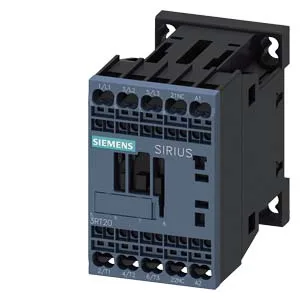
It carries a 24 VDC coil with spring-type terminals — no screwdriver needed for the coil connection, which shaves a few seconds per termination on a build. The main contactor body mounts via screw or snap-on onto 35 mm DIN rail per DIN EN 60715, and the mounting position allows ±180° rotation on a vertical surface plus ±22.5° tilt forward and backward, so panel layout constraints are rarely a showstopper.
The 3RT2017-2AB02 is rated for 750 operating cycles per hour under AC-3 duty (squirrel-cage motor starting) and AC-3e, and 250 cycles per hour under AC-4 (plugging / inching). AC-1 resistive load switching tops out at 1000 cycles per hour. That 750 ops/h at AC-3 is the number that governs most conveyor and pump applications — it means the contactor can handle a start every 4.8 seconds continuously without exceeding thermal limits. The arcing time sits between 10 and 15 ms, which is typical for this frame class and gives the upstream protection device enough time to discriminate.
Auxiliary contact ratings — the switching capacity at different voltages
The built-in auxiliary switch is rated for 10 A at 24 V, 2 A at 48 V and 60 V, 1 A at 110 V, 0.9 A at 125 V, 3 A at 400 V, and 0.2 A at 440 V. These are the make-and-break capacities at each voltage level — the 10 A at 24 V covers most PLC digital output loads, while the 0.2 A at 440 V is the limit for switching a control transformer primary. The 2 hp rating at 230 V gives a quick cross-check for small motor applications on single-phase 230 V systems.
Wiring and thermal limits
Solid and stranded conductors from 0.5 mm² up to 4 mm² are accepted on the main terminals, with double-wire capability (2x 0.5–4 mm²) for daisy-chaining.