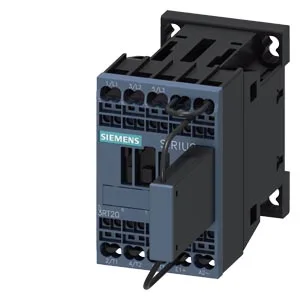
It is part of the SIRIUS family, a broad platform for industrial switching and protection. The coil termination uses spring-type terminals, which means no screwdriver is needed for the control wiring — a time-saver during panel build and a reliable connection that won't loosen under vibration. This is the standard mounting for panel builders; the 45 mm width fits a single modular device pitch.
For DC switching, the contactor is rated 10 A at 24 V, 2 A at 48 V and 60 V, 1 A at 110 V, 0.9 A at 125 V, 3 A at 400 V, and 2 A at 500 V and 690 V. These are the make-and-break capacities for DC loads — the current drops as voltage rises because DC arcs are harder to extinguish. The 10 A at 24 VDC is the figure that matters for most control-circuit or small DC-motor applications. For AC loads, the contactor is rated 11 A at 480 V and 600 V, and 2 hp at 230 V. The 11 A at 480 V is the general-purpose rating for three-phase motor switching in North American 480 V panels; the 2 hp at 230 V covers single-phase motor duty. Electrical life depends on the load type and switching frequency; for high-cycle applications like conveyors, derate accordingly.
Dimensions are 45 mm wide, 70 mm high, and 121 mm deep. These are the minimum air gaps needed for heat dissipation and arc flash — crowding the contactor against other devices or the enclosure wall will shorten its life. Main contact wiring accepts solid or stranded conductors: 2x (0.5 to 1.5 mm²), 2x (0.75 to 2.5 mm²), or 2x 4 mm². The spring terminals grip the wire without needing ferrules, though ferruled stranded wire is still recommended for repeated re-termination.