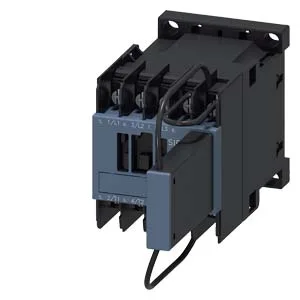
This is a coupling contactor — meaning it is intended to switch control signals or low-power loads between circuits, not to drive motors directly. It carries no built-in auxiliary switch, so any feedback or status signaling requires an external auxiliary contact block. Rated for 10 A at 24 V and 11 A at both 480 V and 600 V, it handles 2 hp at 230 V.
That depth of 73 mm is the dimension that matters most when fitting this into a shallow enclosure or against a back panel with wiring ducts. These are the minimum free-air gaps needed for heat dissipation and arc quenching. If you stack contactors or crowd them against enclosure walls, you must maintain these — no exceptions. Switching frequency limits per duty class: 1000 cycles/hour at AC-1 (resistive), 750 cycles/hour at AC-2 and AC-3 (motor starting/running), 750 cycles/hour at AC-3e, and 250 cycles/hour at AC-4 (plugging/inching).
The 3RT2017-4KB41 is a standard catalog number; no special PCN watch is required. If you are looking at a panel built around a different SIRIUS contactor, the physical fit and electrical ratings are what govern the swap — the DIN-rail footprint is common across the S00 frame, but verify your coil voltage (24 VDC) and load current against the existing part.
A buyer comparing this 3RT2017-4KB41 to the 3RT2026-4BB40 is looking at two different coil voltages. The 3RT2017-4KB41 is a 24 VDC-operated contactor; the 3RT2026-4BB40 is a different voltage variant. Both are S00 frame, both mount on 35 mm DIN rail, both are coupling contactors without built-in auxiliaries. The deciding factor is simply what control voltage your PLC or relay output provides. If your panel runs on 24 VDC control, this is the correct choice. If the panel uses a different coil voltage, you need the corresponding variant.