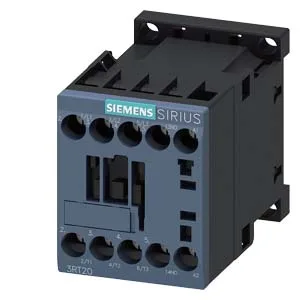
The 3RT2018-1AN24-3MA0: The auxiliary contact breaking capacity is rated at 6 A at 24 V DC, 2 A at 48 V and 60 V, 1 A at 110 V, 0.9 A at 125 V, 0.3 A at 220 V, 3 A at 400 V, and 0.2 A at 440 V. These are the DC-13 inductive load limits — the contact will weld if you exceed them on a DC solenoid or brake coil. The AC-1 maximum switching frequency of 1 000 cycles per hour drops to 750 for AC-2 and AC-3 motor duty, and 250 for AC-4 plugging/inching. That AC-4 limit is the one that bites if you're jogging a conveyor repeatedly. Wire termination accepts solid or stranded conductors from 0.5 to 4 mm², with dual-wire capability up to 2x 4 mm². The main contacts use screw-type terminals with a torque range of 20 to 12 Nm — enough for a solid connection on motor feeders. Coil terminals are also screw-type, so no special crimp tool needed for the control wiring. That helps when retrofitting into an existing panel where the rail isn't perfectly level.
Thermal and environmental limits
The storage range is wider because the contactor isn't switching under load — that's the handling limit, not the running limit. Mechanical endurance is typical 10 000 000 cycles — that's the unloaded mechanical life. Electrical life depends on the switching duty and load current; the AC-4 rating of 250 cycles/hour is the practical limit for severe switching. Arcing time runs 10 to 15 ms, with AC switching times of 4 to 15 ms — fast enough for most motor starter coordination but verify against your upstream breaker's trip curve if you're doing Type 2 coordination.