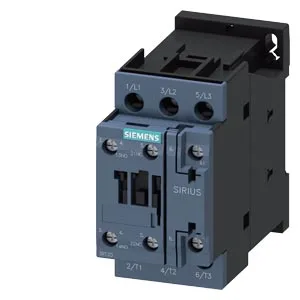
At 45 mm wide and 97 mm deep, it occupies one standard 45 mm module slot on the rail — a dimension that matters when you're laying out a crowded enclosure and need to know exactly how much DIN space each contactor consumes. The contactor includes an integrated auxiliary switch, so you don't need to add a separate side-mount block for basic status feedback or interlocking in the control circuit.
The switching frequency tells you how hard you can cycle this contactor in continuous operation: 1,000 operations per hour for AC-1 (resistive), AC-2 (slip-ring motor), AC-3 (squirrel-cage motor starting), and AC-3e (enhanced AC-3) duty classes. For AC-4 duty — plugging and inching — the rate drops to 300 operations per hour, because the make-and-break on locked-rotor current generates more heat in the arc chamber. The auxiliary contact ratings span the common control voltages you'll find in a panel: 10 A at 24 V, 2 A at 48 V or 60 V, 1 A at 110 V, 0.9 A at 125 V, 0.3 A at 220 V, 3 A at 400 V, 0.6 A at 440 V, 7.6 A at 480 V, and 2 A at 500 V. These are the current-carrying limits for the auxiliary circuit — useful when you're feeding PLC inputs, relay coils, or indicator lamps at different line voltages. The magnet coil connection uses a ring cable lug, which means the coil wires terminate with a crimped ring terminal under a screw — a robust connection that won't vibrate loose on a machine subject to continuous cycling.
This flexibility helps when you're fitting it into a tight corner of the enclosure or aligning it with existing busbars. These are the minimum air gaps to maintain for heat dissipation and arc flash clearance — ignore them and you risk derating or nuisance tripping in a warm cabinet. The storage range is wider because there's no current flowing and no heat to manage — useful to know if the contactor sits in an unheated warehouse before installation.
No broker or surplus channel needed.