What the ratings mean for your motor circuit
The main contacts are rated for AC-1 through AC-4 duty, with a maximum operating frequency of 1,000 switching cycles per hour in AC-1, 750 in AC-2 and AC-3, and 250 in AC-4. That AC-4 figure is the one to watch if you're jogging or inching a motor — those cycles eat contacts faster, and the 250/hour limit tells you this contactor isn't sized for continuous plug-reversing duty. The auxiliary contact set is rated for 10 A at 24 V, 2 A at 48 V, 2 A at 60 V, 1 A at 110 V, 0.9 A at 125 V, 0.3 A at 220 V, and 3 A at 400 V. That 3 A at 400 V is what you'd use to drive a contactor or relay coil in a 400 V control circuit — plenty of headroom for a typical PLC output driving this contactor's own coil through an interposing relay. Main terminals accept 1 to 10 mm² solid or stranded. Auxiliary terminals accept 2x (0.5 to 1.5 mm²) or 2x (0.75 to 2.5 mm²).
Clearance and temperature — what the panel builder needs
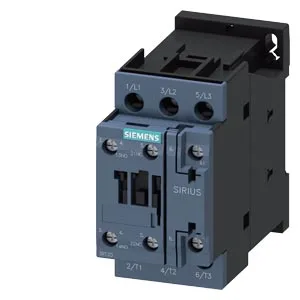
Dimensions: 85 mm high, 45 mm wide, 97 mm deep. Clearance: 10 mm above, 10 mm below, 10 mm forward, 6 mm to side. Operating temperature range is -25 to +60 °C, storage from -55 to +80 °C. That storage range means it can sit in an unheated warehouse or a truck in winter without damage, but the 60 °C operating limit is the one that matters in a hot panel next to a drive or transformer — keep the ambient below that or derate the switching frequency.
