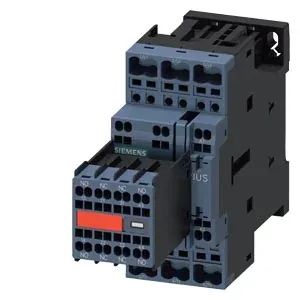
It mounts via screw or snap-on onto a 35 mm DIN rail per DIN EN 60715, and the S0 footprint (102 mm height, 45 mm width, 144 mm depth) fits standard panel layouts where space is allocated for a compact contactor block. The magnet coil termination uses spring-type terminals, which speeds wiring compared to screw clamps — useful on lines where changeover time matters. The coil is rated for 24 VDC nominal; the auxiliary contact ratings vary by voltage, with 6 A at 24 V rated value and 2 A at 48 V or 60 V, so confirm the load on the aux circuit matches the voltage-specific curve.
Switching frequency limits define how often this contactor can cycle without overheating. At AC-1 (resistive load) it handles up to 1 000 operations per hour; at AC-3 (motor starting) and AC-3e (enhanced motor) the limit is 750 per hour. For AC-4 (inching/plugging duty) it drops to 250 per hour — a hard constraint for applications like reversing conveyors or jogging cranes. Solid or stranded wire from 1 to 10 mm² is accepted on the main terminals, and the auxiliary circuit accepts 2x (0.5 to 2.5 mm²) — standard for control wiring. The contactor has no built-in auxiliary switch, so if you need a mirror contact or early-make/early-break, you'll add a separate auxiliary contact block.