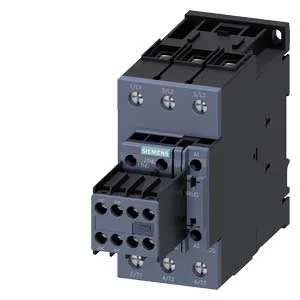
SIRIUS S2 Power Contactor — 3RT2035-3SF30
The coil accepts 83 to 150 V AC/DC, with a pick-up threshold of 0.8× rated (about 66 V) and a drop-out of 0.1× rated (about 8 V). Inrush current peaks at 25 A, then settles to 2 VA at both 50 and 60 Hz — a tight coil draw that keeps the control transformer small. Rated operational current is not explicitly listed here, but the S2 frame size and the switching-frequency limits (1 000 ops/h at AC-1, AC-3, AC-3e; 750 at AC-2; 300 at AC-4) tell the story: this contactor is built for moderate-duty motor starting and resistive switching, not high-cycle jogging or plugging.
The 55 mm width (three 18 mm modules) fits standard enclosure rail spacing. Depth is 130 mm, height 114 mm — check clearance against the enclosure door or busbar shroud. Clearance distances: 10 mm upwards, downwards, and forwards; 6 mm to the side. Keep these free for arc-flash venting and airflow.
Termination and Auxiliary Contacts
Main and coil connections use spring-type terminals (cage clamp), accepting 2× (0.5 to 2.5 mm²) solid or stranded. No screw torque to verify — a time-saver on repetitive panel builds. The contactor includes an auxiliary switch block (18 to 1 configuration — likely 1 N/O + 1 N/C). Its ratings: 10 A at 24 V, 2 A at 48 V and 60 V, 1 A at 110 V, 0.9 A at 125 V. These are the DC-13 inductive load limits; for AC pilot duty, the thermal current is higher.
Environmental and Reliability
The 52 a MTBF (mean time between failures) reflects a mechanical/electrical endurance typical for a SIRIUS S2 — expect millions of operations under rated load. Arcing time is 10 to 20 ms; opening and closing times (AC and DC) are 30 to 55 ms. These are fast enough for most motor starter coordination but should be checked against upstream breaker trip curves for selectivity.