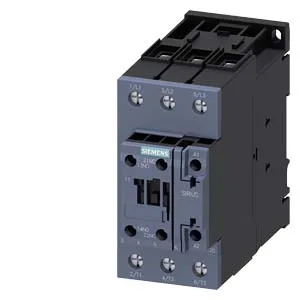
Siemens 3RT2036-1AV60 SIRIUS Power Contactor, 52 A, 480 V
Siemens SIRIUS 3RT2036-1AV60 power contactor, S2 size, 3 NO + 1 NC main contacts, 52 A at 480 V, 55 mm width, screw and snap-on 35 mm DIN rail mount.
Specifications
| Parameter | Value |
|---|---|
| Contactor frame size | S2 |
| Parameter | Value |
|---|---|
| Rated operational current, AC-12, max. | 10 A |
| Rated operational current, AC-4 @ 400 V | 41 A |
| Rated value @ 400 V | 3 A |
| Rated value @ 500 V | 2 A |
| Rated value @ 690 V | 1 A |
| Rated value @ 230 V | 10 hp |
| Rated value @ 24 V | 10 A |
| Rated value @ 60 V | 2 A |
| Rated value @ 110 V | 1 A |
| Rated value @ 220 V | 0.3 A |
| Parameter | Value |
|---|---|
| Control supply voltage type | AC |
| Parameter | Value |
|---|---|
| Main poles | 3 |
| Main NO contacts | 3 |
| Auxiliary contact reliability | 1 faulty switching per 100 million (17 V, 1 mA) |
| Parameter | Value |
|---|---|
| Short-circuit coordination type 1, fuse | gG: 160 A (690 V, 100 kA), aM: 80 A (690 V, 100 kA), BS88: 125 A (415 V, 80 kA) |
| Short-circuit coordination type 2, fuse | gG: 80A (690V,100kA), aM: 50A (690V,100kA), BS88: 63A (415V,80kA) |
| Aux. switch short-circuit protection, fuse | gG: 10 A (500 V, 1 kA) |
| Parameter | Value |
|---|---|
| Main circuit connection | screw-type terminals |
| Aux. / control circuit connection | screw-type terminals |
| Conductor cross-section, solid or stranded | 2x (0.5 ... 1.5 mm²), 2x (0.75 ... 2.5 mm²) |
| Conductor cross-section, finely stranded w/ ferrule | 2x (0.5 ... 1.5 mm²), 2x (0.75 ... 2.5 mm²) |
| Mounting method | screw and snap-on mounting onto 35 mm DIN rail according to DIN EN 60715 |
| Side-by-side mounting | Yes |
| Parameter | Value |
|---|---|
| Durability (operating cycles, typ.) | 10 000 000 |
| Durability with aux. switch block (cycles, typ.) | 10 000 000 |
| Parameter | Value |
|---|---|
| Operating temperature range | -25 ... +60 °C |
| Storage temperature range | -55 ... +80 °C |
| Installation altitude, max. | 2 000 m |
| Parameter | Value |
|---|---|
| Width | 55 mm |
| Height | 114 mm |
| Depth | 130 mm |
| Parameter | Value |
|---|---|
| At AC | 10 ... 18 ms |
Product details
Frequently asked questions
What compliance documentation does Siemens provide for 3RT2036-1AV60?
RoHS and REACH declarations are standard for current-production Siemens contactors; UL and CSA file numbers are typically printed on the side label.
52 A at 480 V — the AC-3 motor rating that decides the fit
The 3RT2036-1AV60 is a SIRIUS S2 power contactor rated 52 A at 480 V — this is the AC-3 switching current for standard squirrel-cage motor duty, not the resistive AC-1 figure. That 52 A at 480 V means it handles a 30 hp motor at 480 V without the contacts welding on break. Main contact configuration is 3 normally-open plus 1 normally-closed (18...1 per the spec), so the NC pole can serve as a mirror contact or auxiliary interlock without an add-on block.
Panel fit: 55 mm wide, 130 mm deep, DIN-rail snap-on
Width is 55 mm — that is three 18 mm module slots plus 1 mm clearance on a standard DIN-rail panel. Side clearance to adjacent devices is 6 mm; forward and upward clearance is 10 mm each. That is tight enough for a 55 mm wide contactor to sit next to a matching overload relay without a spacer.
Switching frequency and coil termination
Maximum mechanical switching rate is 800 operations per hour in AC-3 duty and 1,000 in AC-1. For frequent jogging or inching applications, the AC-4 ceiling of 250 ops/hour is the limiting factor — exceeding that accelerates contact erosion. The auxiliary switch is built in — no separate block needed for the NC mirror contact. Arcing time is 10 to 18 ms at AC — this sets the coordination window for the upstream short-circuit protection device. A 52 A contactor with 18 ms arc time typically coordinates with a 63 A gG fuse or a 50 A circuit breaker at the available fault current.
Active production — no lifecycle concern
The 60 °C ceiling means the contactor can sit in a non-ventilated enclosure up to that ambient without forced cooling, though the coil holding power and contact resistance both rise above 40 °C.