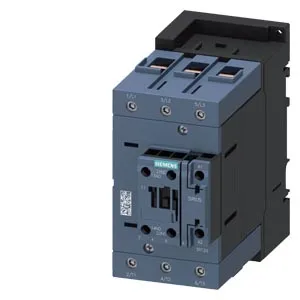
It includes a factory-fitted auxiliary switch block, so you don't need to order a separate side-mount for basic feedback or interlock circuits.
The auxiliary contact block carries a rated current of 10 A at 24 V DC, derating to 2 A at 48 V and 60 V, and further to 0.3 A at 220 V DC. This is a resistive load curve; inductive loads (relays, small solenoids) will need a flyback diode or RC snubber to stay within the contact's make/break capability. At 230 V AC the auxiliary contacts handle 6 A, and at 400 V AC they drop to 3 A. Maximum switching rates vary by duty: 900 operations per hour at AC-1 (resistive), 850 at AC-3 (squirrel-cage motor starting), and 250 at AC-4 (plugging/inching).
Mounting and wiring considerations
The contactor accepts solid conductors from 2.5 to 16 mm² on the main power terminals, and stranded conductors from 6 to 70 mm². The auxiliary terminals accept 2x (0.5 to 1.5 mm²) solid or stranded, or 2x (0.75 to 2.5 mm²). Keep the strip length consistent with screw-clamp practice — about 10 mm for the main terminals, 8 mm for auxiliaries — to avoid insulation under the clamp. That 20 mm forward clearance is the one most often missed in dense panels — the arcing space for the main contacts plus the auxiliary wiring loop needs that room. Mounting position is standing on a horizontal surface; side or inverted mounting is not specified and should be avoided.
No cross-reference or alternate MPN is required while the lifecycle remains active.