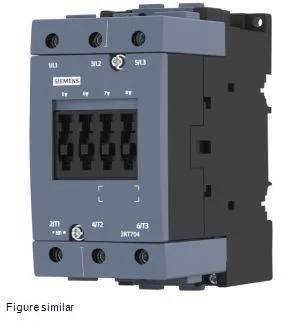
The Siemens 3RT7046-1AC20 is a SIRIUS size S3 contactor with three main poles, each normally open, and a 24 VAC 50/60 Hz coil. The S3 frame size and 70 mm width mean it's a mid-range contactor — bigger than the S0 and S2 frames, smaller than the S6 and S10. It's meant for panels where you need more contactor capacity without jumping to the next mounting footprint. Mounting is flexible: screw-fix or snap onto 35 mm or 75 mm standard DIN rail.
Closing power draw is 0.7 W DC; holding power drops to 0.29 W DC — the holding economy keeps the coil cooler and cuts wasted heat in a densely packed panel. Auxiliary contacts are rated for PLC-level signals — the spec calls out reliability at 17 V, 5 mA, which means you can wire this contactor's aux straight into a 24 VDC digital input card without worrying about contact wetting failures. The auxiliary contact block is field-addable (product extension auxiliary switch is supported), so you don't have to order a different variant if you need more N.O. or N.C. feedback later.
Main circuit ratings and protection
Rated insulation voltage 690 V, surge voltage resistance 6 kV, pollution degree 3. That's the standard coordination for this frame size — don't undersize the fuse if you want the contactor to survive a fault. Maximum switching frequency is 800 operations per hour under AC-3 duty (motor switching) and 250 operations per hour under AC-4 (plugging/reversing). If your application cycles faster than that, step up to a larger frame or a dedicated switching device.
The storage limit is for handling and warehousing — don't run it at +70 °C, but it can sit in a hot warehouse or truck without damage. Shock resistance is 10.6 g for 5 ms and 6.2 g for 10 ms (sine pulse at AC). That's typical for a panel-mounted contactor — it'll handle normal machine vibration but don't mount it directly on a vibrating pump or crusher without isolation.
Screw-type terminals on main and auxiliary circuits. Wire sizes: 2 x (0.5 to 1.5 mm²) or 2 x (0.75 to 2.5 mm²). The front of the contactor is IP20 (finger-safe), but the terminals themselves are IP00 — so live parts are exposed at the connection points. Standard practice: keep the panel door interlocked or use finger-safe shrouds if the contactor is accessible during operation.