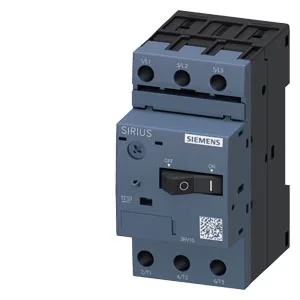
The Siemens SIRIUS 3RV1011-0CA20 is a motor protection circuit breaker rated for 0.25 A continuous current with a CLASS 10 trip characteristic, meaning it will trip within 10 seconds at 7.2× rated current — fast enough to protect standard induction motors during locked-rotor conditions without nuisance tripping on normal starts. Breaking capacity hits 100 kA at 240 V, 400 V, 500 V, and 690 V AC, so it can interrupt high-fault-current events across a wide voltage range without upstream fusing in most panels.
Compared to the 3RV1011-0GA10, which is a higher-current variant in the same frame size, the 3RV1011-0CA20 shares the same 45 mm width, 90 mm height, and 81 mm depth, so it drops into the same DIN-rail footprint without panel rework — the only difference is the thermal-magnetic rating and the trip curve setting.
It carries IP20 protection on the front, suitable for enclosed panel use where no washdown or outdoor exposure is expected. Operating temperature range is -20 to +60 °C, storage and transport from -50 to +80 °C, and altitude up to 2 000 m without derating.
Spring-loaded terminals accept 2x (0.25... 2.5 mm²) solid or 2x (0.25... 1.5 mm²) finely stranded with ferrules, and 2x (24... 14) AWG for the main contacts — strip length and ferrule size should match the terminal design to avoid loose connections. The breaker includes an auxiliary switch (yes), so it can signal its status to a PLC or indicator light without an add-on block. Rated insulation voltage is 690 V, surge voltage resistance 6 000 V, and mechanical endurance is 100 000 cycles — typical for a motor-protection device in a panel that sees regular switching. Power dissipation is 5.5 W total in hot operating state (1.8 W per pole), so panel heat buildup stays manageable even in a dense row of breakers.