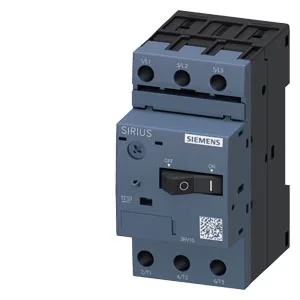
Motor protection circuit breaker for Class 10 trip curves
The Siemens 3RV1011-0FA10-ZX95 is a SIRIUS-brand motor protection circuit breaker designed for motor loads where the start-up time demands a Class 10 trip characteristic — meaning it allows up to 10 seconds at locked-rotor current before tripping, which nails the cure recipe for a tire press motor that needs a controlled acceleration ramp without nuisance trips. Rated breaking capacity hits 100 kA at 400 V AC, so it safely interrupts fault currents up to that level without cascading upstream — essential for a panel that needs SCCR headroom on a 400 V line feeding multiple press drives. Phase failure detection is built in, which protects the motor from single-phasing — a common failure mode in industrial environments where a blown fuse or loose connection on one phase can cook a winding before the overload element reacts.
Mounting and integration
Mounts via screw and snap-on onto 35 mm DIN rail per DIN EN 60715, so it drops into any standard panel enclosure. The mounting position is any orientation, which simplifies layout in a crowded cabinet. Dimensions: 45 mm wide, 90 mm high, 75 mm deep. The 45 mm width is a standard 2-module footprint on a DIN rail — same as the 3RV1011-0GA10, so a panel specced around that sibling accepts this unit without rewiring the rail. Clearance requirements: 20 mm upwards, 20 mm downwards, 9 mm at the side, 0 mm forwards and backwards. No extra space needed front or rear — tight-panel friendly.
Operating conditions and ratings
Operates from -20 to +60 °C; stores and transports from -50 to +80 °C. That storage range covers frozen warehouses and hot shipping containers — the part holds up to the temperature extremes a tire-curing plant sees during off-season storage. Rated voltage range is 20 to 690 V. At 690 V, the required backup fuse is gL/gG 4 A; at 240, 400, and 500 V, no backup fuse is required. That simplifies the BOM for 400 V panels — one less component to source. Maximum switching frequency at AC-3 and AC-3e duty is 15 operations per hour. That's typical for a motor starter protecting a pump or conveyor that cycles a few times per hour — not for a high-speed pick-and-place application.
