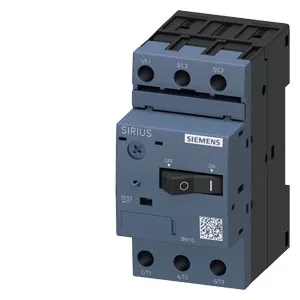
It includes phase failure detection, so if one phase drops out on a three-phase motor, the breaker will trip before the motor overheats on single-phasing. There is no ground fault detection built in, so that function would need to be handled separately upstream or in the drive.
For backup fuse coordination: at 400 V, the required upstream gL/gG fuse is 35 A. At 240 V, no backup fuse is required per the datasheet — the breaker is fully rated for that voltage without additional protection.
Mounting position is any orientation, so it can be placed horizontally or vertically without derating. Clearance requirements: 20 mm upwards, 20 mm downwards, 9 mm at the sides, 0 mm forwards and backwards. That 0 mm backwards clearance means it can sit flush against the back panel or a busbar without additional spacing. Terminals are screw-type for the main current circuit, accepting 2x (0.5 to 1.5 mm²) or 2x (0.75 to 2.5 mm²) solid or stranded conductors. Main contact screws are M3.
Environmental and operational limits
The wider storage range governs handling during shipping and warehouse storage, not running conditions. Maximum operating cycles per hour under AC-3 duty (motor switching) is 15 per hour. Same limit applies under AC-3e duty. This is a thermal limit on the bimetal trip mechanism — exceeding it can cause nuisance tripping from accumulated heat.
For BOM freeze or PCN watch purposes, this part is stable. If you are specifying it into a new design, the SIRIUS platform has broad cross-reference compatibility within the 3RV10 family for different current ranges, but the 3RV1011-1BA10 itself is a current-production order code.