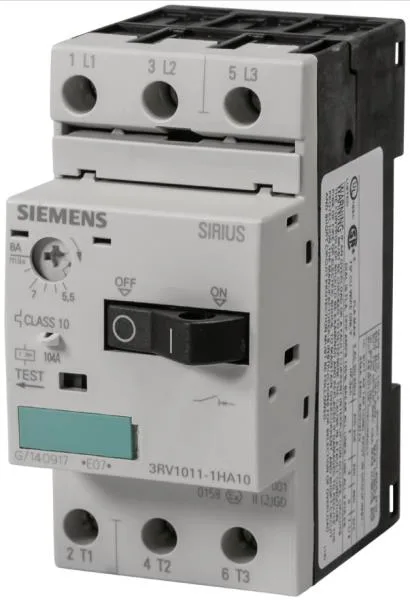
It also includes phase failure detection, which prevents single-phasing damage on three-phase motors.
At 400 V it drops to 13 kA, at 500 V to 3 kA, and at 690 V to 2 kA, so verify your site's prospective short-circuit current at the actual line voltage. The rated voltage range is 20 to 690 V, covering common motor control voltages from 24 V control transformers up to 690 V industrial mains. Motor horsepower ratings are given for several common voltages: 1 hp at 230 V, 0.33 hp at 110/120 V, 2 hp at 200/208 V, and 2 hp at 220/230 V. These are the maximum motor sizes the breaker can protect at those voltages, assuming standard full-load current. The switching frequency is rated at 15 operations per hour for AC-3 duty (motor starting), which is typical for a motor protection breaker — not intended for frequent jogging or high-cycle applications.
Clearance requirements: 20 mm upwards, 20 mm downwards, 9 mm at the sides, 0 mm forwards and backwards. Main circuit terminals are screw-type, accepting 2x (0.5 to 1.5 mm²) or 2x (0.75 to 2.5 mm²) solid or stranded wire. Terminal screw size is M3.