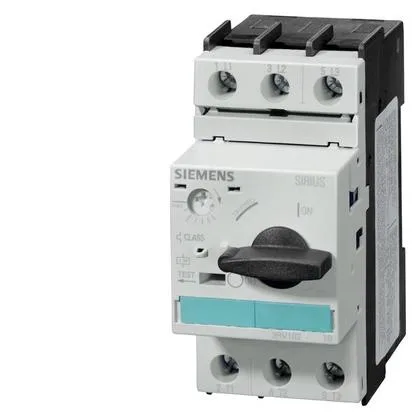
It carries a continuous current rating of 4 A and a trip class of CLASS 10, meaning it will trip within 10 seconds at 7.2x the current setting — fast enough to protect standard induction motors during a locked-rotor event without nuisance tripping on normal starts. No ground fault detection on this variant, so pair it with a separate ground-fault relay if that's required by code.
The 45 mm width takes up a single 9 mm module equivalent on the rail — five of these fit in a standard 225 mm wide enclosure row. Screw-type terminals on both main and auxiliary circuits accept solid or stranded wire: 2x (1 … 2.5 mm²) or 2x (2.5 … 6 mm²) per clamp. AWG equivalents are 2x (14 … 10). Finely stranded wire with ferrule is handled the same way — no special tooling needed beyond a standard screwdriver. Mounting position is any orientation. Shock resistance rated at 25g / 11 ms, so it holds up in mobile equipment or near vibrating machinery.
RoHS compliance is indicated by the substance prohibition date of 01.05.2012, which aligns with the EU RoHS directive. No UL or CSA listing is stated in the spec record, so verify jurisdictional acceptance if your project requires those marks.
Power Dissipation and Duty Cycle
That's modest — no forced cooling needed in a standard IP20 enclosure, but account for it in thermal calculations if you're packing multiple units in a small cabinet. Maximum operating frequency in AC-3 duty is 15 operations per hour. That's fine for motor starting in pump or fan applications; don't use it for frequent jogging or reversing cycles without checking the thermal accumulation.