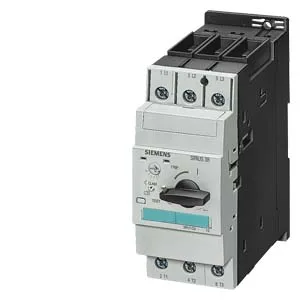
The Siemens 3RV1031-4HB10 is a SIRIUS motor-protection circuit breaker rated for 50 A continuous current and 22 kW at 400 V, with a CLASS 20 trip characteristic. That CLASS 20 curve allows the breaker to ride through the high inrush of a standard induction motor start (typically 6–8× FLA for 10–20 seconds) without nuisance tripping, while still protecting against locked-rotor and overload conditions. The 50 A continuous rating and 22 kW at 400 V mean it is sized for a motor load up to that power — a 30 hp (22 kW) four-pole motor at 400 V draws roughly 42–45 A full-load, so the 50 A frame gives headroom for ambient derating or a slightly oversized motor.
Short-circuit coordination — what the SCCR ratings mean for panel design
This breaker carries a 100 kA interrupting rating at 240 V AC, 50 kA at 400 V, 10 kA at 500 V, and 4 kA at 690 V. The breaker also includes phase failure detection, which trips on loss of one phase — a common cause of single-phasing motor damage that a standard thermal overload might miss.
Mounting and integration — DIN rail fit, wiring, and clearances
Width is 55 mm, height 140 mm, depth 149 mm. No side clearance required (0 mm backwards and at the side), so you can pack breakers tight on the rail. Main circuit terminals accept solid 2x (0.75…16 mm²) or stranded 2x (0.75…25 mm²) and 1x (0.75…35 mm²). Auxiliary and control circuit terminals are screw-type.