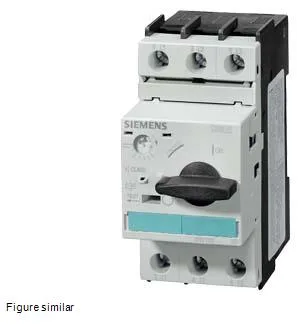
The CLASS 10 trip characteristic matches the inrush profile of small control transformers, so nuisance tripping on energization is minimized.
The 0.16 A continuous rating sets the maximum steady-state load without thermal trip. For a three-phase control transformer feeding a rectifier or multiple single-phase loads, this is a practical safeguard that a standard MCB won't give you. In a panel with a large upstream transformer or a stiff utility feed, that SCCR headroom keeps the breaker from becoming the weak link in the coordination study. Auxiliary contact ratings: 1 A at 24 V, 0.5 A at 230 V, 0.15 A at 60 V. These are the switching limits for the built-in auxiliary contacts — use them to signal the breaker's state to a PLC or annunciator. The 24 V rating covers the common control voltage in most panels; the 230 V rating lets you drive an indicator lamp directly without an interposing relay. Power loss of 5.5 W in hot operating state at AC.
The 45 mm width occupies one standard modular unit, so it fits alongside MCBs and contactors in a conventional DIN-rail layout. Dimensions: 45 mm wide, 97 mm high, 96 mm deep. The 96 mm depth is the front-to-back footprint — verify clearance behind the DIN rail, especially if the panel has a back plate or a rear wiring duct. Wire cross-sections: solid 2x (0.5...1.5 mm²) and 2x (0.75...2.5 mm²); stranded 2x (1...2.5 mm²) and 2x (2.5...6 mm²). AWG for main contacts: 2x (14...10). These cover the typical control wiring sizes — no need for ferrule adapters on stranded wire up to 2.5 mm².
The storage range exceeds the operating range — that's the handling limit, not the running limit. Shock resistance 25g / 11 ms, adequate for most industrial machinery and conveyor applications. Substance prohibitance date 01.05.2012 — this is the RoHS compliance cutoff. The part meets the RoHS directive as of that date, so it's acceptable for EU-market equipment and for customers with RoHS procurement requirements.