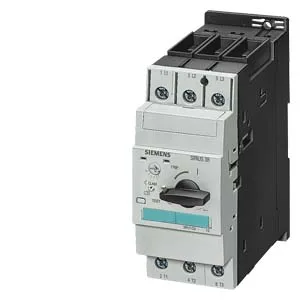
Transformer protection breaker, 40 A, Class 10
Rated voltage goes to 690 V, with breaking capacities that step down as voltage rises: 100 kA at 240 V, 50 kA at 400 V, 10 kA at 500 V, and 4 kA at 690 V. Ground fault detection is not included — that would need an external module or a separate GFCI device.
Terminal capacity: solid conductors 2x 0.75–16 mm²; stranded 2x 0.75–25 mm² or 1x 0.75–35 mm². Finely stranded with ferrules: 2x 0.75–16 mm² or 0.75–25 mm². AWG equivalents: 2x 18–2 or 1x 18–2. That 35 mm² single-conductor option is handy for the line-side feed on a 40 A circuit — keeps the wire count down in a crowded trough. Dimensions: 55 mm wide, 140 mm high, 149 mm deep. Zero clearance needed at the back or sides — the breaker can sit flush against the panel wall or adjacent devices without derating.
Shock resistance rated at 25 g for 11 ms — survives the typical shipping and panel-door slam without nuisance trips. Lifecycle status is current production. The part is actively manufactured by Siemens under the SIRIUS brand. RoHS compliance date is noted as July 1, 2006 — the EU RoHS effective date — meaning the design predates later amendments but meets the original substance restrictions. Power dissipation at full load in hot state: 29 W total, 9.7 W per pole. That matters for thermal coordination inside a sealed enclosure — at 29 W you need some airflow or a larger cabinet if multiple breakers are ganged.
Switching duty and auxiliary options
Maximum operating frequency in AC-3 motor-switching duty is 15 operations per hour. That is fine for transformer protection where the breaker cycles at commissioning and on fault events — not designed for frequent motor start/stop service. Surge voltage withstand is 6 kV, covering the transient environment of industrial control panels. The design accepts auxiliary switch modules — a separate order for the side-mount block if remote status indication is needed. No auxiliary switch is included with the base breaker.