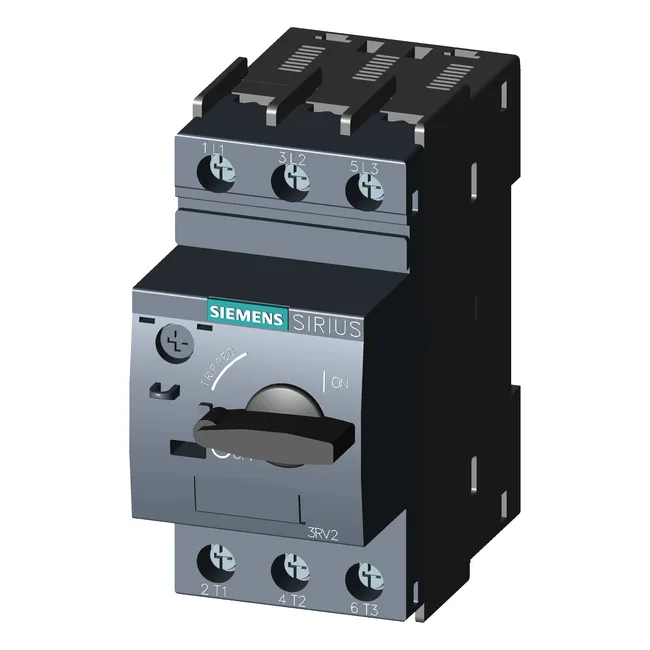
Motor protection circuit breaker, SIRIUS series — 3RV2011-0AA15-ZX95
Trip Class 10 ensures the breaker trips within 10 seconds at 7.2× the thermal setting, matching standard IEC/EN 60947-4-1 requirements for motor protection.
Clearance: 50 mm upward and downward, 30 mm at the side, 0 mm forward and backward — so you can butt it against a backplane or adjacent devices on the rail. Main circuit terminals accept 2×(0.5…1.5 mm²) or 2×(0.75…2.5 mm²) solid or stranded wire, M3 screw-type. Storage and transport range -50 to +80 °C. The -20 °C floor means it's fine for unheated enclosures in temperate climates, but not for deep-freeze or arctic installations.
Duty cycle and switching ratings
Maximum switching rate in AC-3 duty is 15 operations per hour — sized for occasional motor starts, not high-cycle applications like rapid reversing or jogging. For higher cycle rates, step to the 3RV2 series with higher mechanical endurance. Auxiliary contact ratings: 1 A at 24 V, 0.5 A at 120/125/230 V, 0.15 A at 60 V. These are typical for signaling back to a PLC input or a contactor coil; stay within these limits to avoid contact welding.