What it is and what it does
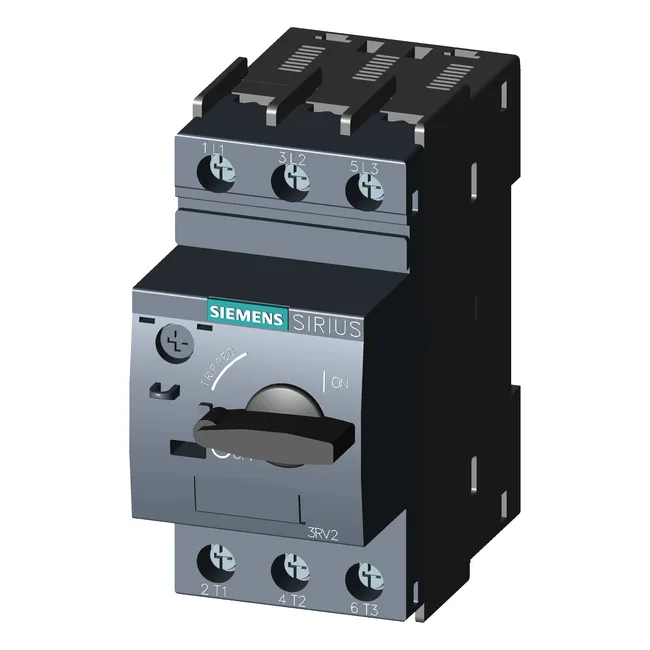
The Siemens 3RV2011-0BA10-ZX95 is a SIRIUS motor protection circuit breaker, size S00, designed specifically for motor protection. Its job is to combine a circuit breaker's short-circuit interruption with a thermal overload relay's motor protection curve — one device, one DIN-rail footprint, no separate overload relay needed downstream. Trip Class 10 means it clears an overload within 10 seconds at 7.2× the set current, which is the standard for standard-duty induction motors — pumps, fans, compressors. Phase failure detection is built in, so a lost phase on the line side will trip the breaker before the motor single-phases and cooks the winding. Breaking capacity sits at 100 kA at 400 V AC, 500 V AC, and 690 V AC — that's the fault current it can safely interrupt without welding contacts or venting plasma. At 240 V AC it's also 100 kA. For most industrial distribution panels with a transformer upstream, that's enough SCCR headroom to avoid a cascading failure.
Mounting and panel fit
Mounts on 35 mm standard DIN rail per DIN EN 60715 — screw and snap-on, so it clips in place and can be screwed down for vibration resistance. Size S00 means a 45 mm width, 97 mm depth, 97 mm height. Clearance requirements: 50 mm above and below, 30 mm to the side, zero forward or backward. That keeps heat dissipation and arc-flash clearance predictable in a crowded panel. Terminals are M3 screw-type for the main current circuit, accepting 2×(0.75…2.5 mm²) or 2×4 mm² solid/stranded. Pozidriv size 2 tip, screwdriver shaft diameter 5 to 6 mm. Strip length and torque aren't listed here, but the M3 terminal class is standard for this frame size.
Lifecycle and sourcing reality
Operating temperature range is -20 to +60 °C; storage and transport range is -50 to +80 °C. That covers most indoor panel environments and unheated warehouses.
What the ratings mean for your choice
The 100 kA breaking capacity at 400 V is the headline number for panel coordination. If your available fault current at the panel is, say, 65 kA, this breaker has margin. If it's 120 kA, you need a current-limiting upstream device or a different frame. The 100 kA rating holds at 500 V and 690 V too, so it works on 480 V and 600 V class systems without derating the interrupt rating. Trip Class 10 and phase failure detection mean this breaker is tuned for motor starting duty, not just resistive load protection. If you're protecting a motor that takes longer than 10 seconds to start (high-inertia loads like centrifuges or large fans), Class 10 may nuisance-trip — you'd want Class 20 or 30. For standard industrial motors, Class 10 is the default.
