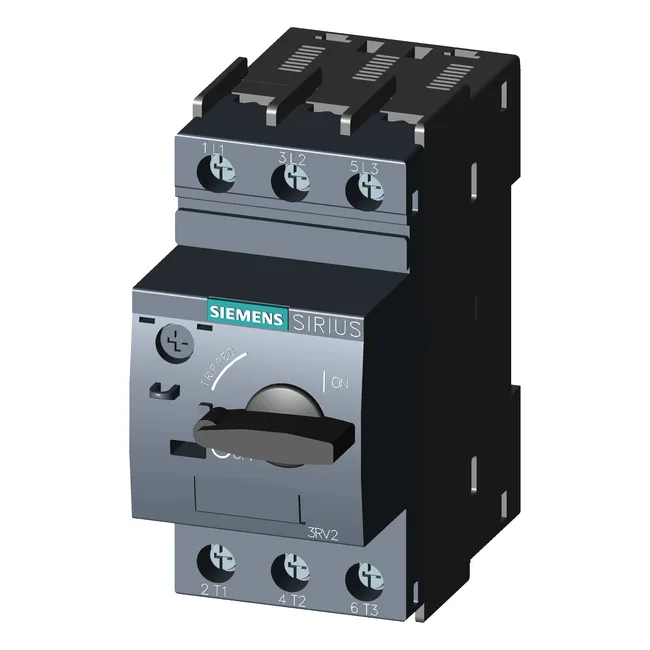
The Siemens SIRIUS 3RV2011-1DA10-ZW97 is a motor protection circuit breaker designed for the 3RV2 frame. It's the part you spec when you need coordinated motor branch protection with a Trip Class 10 thermal-magnetic trip curve, meaning it clears a stalled-rotor overload fast enough to protect standard IEC induction motors without nuisance tripping on normal starting inrush. Rated breaking capacity hits 100 kA at 400 V AC — that's a high-fault-current rating, so it can be used on the line side of a motor starter without needing a separate current-limiting fuse upstream, provided the available fault current at the panel doesn't exceed that figure. It mounts via screw and snap-on onto 35 mm DIN rail per DIN EN 60715, and the mounting position is any orientation, which simplifies panel layout when you're tight on vertical space.
Panel Fit and Clearances
Dimensions are 45 mm wide, 97 mm high, and 97 mm deep. Required clearances: 50 mm above and below, 30 mm to the sides, and zero forward or backward. That 50 mm vertical gap is for heat dissipation from the bimetal trip element — don't cram it against a cable duct or another heat source. Terminals accept 2x (0.75 to 2.5 mm²) solid or stranded, or 2x 4 mm², with M3 screws for the main circuit. That's enough for the motor leads on a 3–5 kW motor at 400 V.
Protection Characteristics
Trip Class 10 means the thermal overload element trips within 10 seconds at 7.2× the current setting — fast enough for standard squirrel-cage motors, but not for high-inertia loads that need Class 20 or 30. Phase failure detection is built in, so it will trip on a single-phased motor before the winding overheats. Breaking capacity varies with voltage: 100 kA at 240 V and 400 V, 100 kA at 500 V, then drops to 10 kA at 690 V. At 690 V, you need to verify the available fault current is under 10 kA, or add a current-limiting fuse ahead of it. The gL/gG fuse coordination values are 25 A at 400 V, 32 A at 500 V, and 25 A at 690 V — these are the maximum upstream fuse ratings that still allow selective coordination with the breaker's magnetic trip.
